Top 10 Smartest Birds
The phrase 'bird-brain' is rapidly dying out as the hidden intelligence of birds is revealed. This list explores the smartest of the avians that roam the Earth.
-
Crows
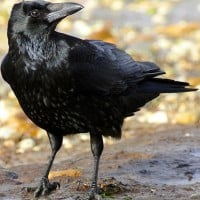
The social engineer.
Crows are masterminds of planning, politics, and payback. They can recognize dozens of human faces for years, coordinate mob attacks on predators, and pass warnings to future generations. They perform funerals, drop nuts under cars to crack them, and show an uncanny grasp of cause and effect.
Their minds rival great apes in several domains:
- Tool use and innovation, such as using sticks, traffic lights, or their own feathers
- Social strategy, manipulating others in their groups
- Collective learning, where their knowledge evolves culturally and not just individually
They're the ultimate mix of intelligence and cunning, a true civilization bird.
-
Ravens
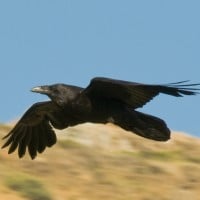
My team name in soccer is Ravens because they are smart.
-
Jays
-
Parrots
The strategist parrot.
An endangered Bolivian species that's stunningly intelligent and emotionally expressive. They understand object permanence, follow social hierarchies, and communicate across long distances with nuanced call patterns, sometimes "imitating" the dialects of neighboring flocks. Captive individuals have been documented inventing new call variants to communicate privately with their chosen humans.
A mind built for both structure and intimacy.
The linguistic philosopher.
African Greys are not just good talkers, they understand what they say. The late Alex the parrot, studied by Dr. Irene Pepperberg, could identify colors, shapes, numbers, and even zero while grasping abstract ideas like same and different.
They've demonstrated:
- True language comprehension, not mimicry
- Logical reasoning, such as choosing correctly between objects by category or request
- Empathy and emotional attachment to humans and other parrots
They even invent new vocal combinations to describe unfamiliar objects, which is an act of spontaneous creativity.
It doesn't just speak words, it asks questions about existence.
-
Cormorants
They can count up to seven.
In the 1970s on the Li River, Pamela Egremont observed fishermen who allowed the birds to eat every eighth fish they caught. Writing in the Biological Journal of the Linnean Society, she reported that once their quota of seven fish was filled, the birds "stubbornly refuse to move again until their neck ring is loosened. They ignore an order to dive and even resist a rough push or a knock, sitting glum and motionless on their perches." Meanwhile, other birds that had not filled their quotas continued to catch fish as usual. "One is forced to conclude that these highly intelligent birds can count up to seven," she wrote.
- Wikipedia
-
Magpies
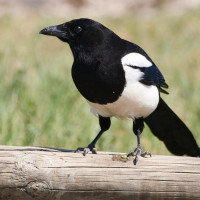
The philosopher corvid.
Magpies are the only non-mammal confirmed to pass the mirror self-recognition test, meaning they understand their own reflection. They mourn their dead, form alliances, cache food with memory precision, and even hold what look like funerals. Their problem-solving skills rival young primates, but their emotional range is what sets them apart.
The magpie isn't just smart, it's self-aware.
They can recognize human faces and can even bond with people.
True. I have bonded with one already.
-
Pigeons
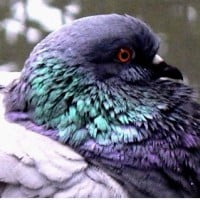
Pigeons and doves are members of the bird family Columbidae, which includes more than 350 species. These birds are characterized by stout bodies, short necks, and slender bills. They primarily feed on seeds, fruits, and plant material.
The urban mathematician.
Pigeons are far smarter than their reputation suggests. They can recognize themselves in mirrors (partially), differentiate all 26 letters of the alphabet, and even distinguish between Picasso and Monet in experiments. Their navigation skills are legendary. They remember thousands of visual landmarks and use infrasound, magnetism, and smell in combination.
A city survivor that quietly solves geometry while eating crumbs.
-
Cuckoos
-
Geese
-
Eagles
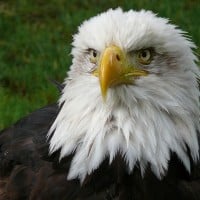
Eagle is the common name for many large birds of prey in the family Accipitridae. Eagles belong to several genera, some of which are closely related, and more than 60 species are found across much of the world. Most eagle species live in Eurasia and Africa.... read more
-
?
Shoebills
-
?
Roadrunners
-
Chickens
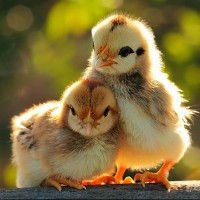
The chicken is a domesticated bird descended primarily from the red junglefowl. It is one of the most common and widespread domestic animals, with a global population exceeding 26.5 billion as of 2023. Chickens are kept primarily for their meat and eggs and are found in nearly every part of the world... read more
-
Owls
-
Penguins

Penguins (order Sphenisciformes, family Spheniscidae) are aquatic, flightless birds found almost exclusively in the Southern Hemisphere. The only species found north of the Equator is the Galápagos penguin. Penguins are highly adapted to marine life, featuring countershaded plumage and flippers for efficient... read more
-
Mockingbirds
-
Woodpecker Finches
-
Falcons
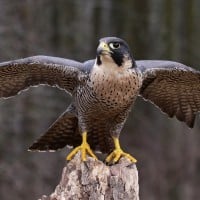
Falcons are birds of prey in the genus Falco, which includes about 40 species. These birds are widely distributed across every continent except Antarctica, although closely related raptors lived there during the Eocene period.... read more
-
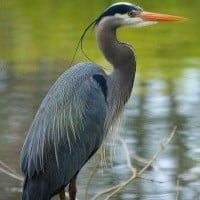
Herons
-
Ostriches
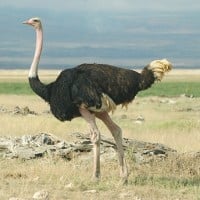
The ostrich, or common ostrich, is one of two extant species of large flightless birds native to Africa. It is the only extant member of the genus Struthio and belongs to the family Struthionidae. In 2014, the Somali ostrich was officially recognized as a separate species from the common ostrich.
-
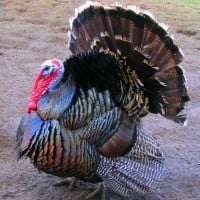
Turkeys
-
Toucans
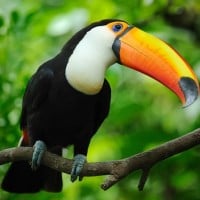
Toucans are members of Ramphastidae, a family of near-passerine birds native to the Neotropics. They are recognizable by their large, colorful bills, which are used for feeding and thermoregulation. Toucans are primarily frugivorous but also consume insects and small animals.
-
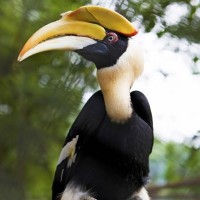
Hornbills
-
Ducks

-
Doves

Pigeons and doves constitute the bird family Columbidae, which includes 352 recognized species. They are generally stout-bodied birds with short necks and short, slender bills. They primarily feed on seeds, fruits, and plants and are found worldwide except in the driest and coldest regions.
-
Emus