Top Ten Best Tanagers and Cardinals
Nature's living paint palette.
If warblers are tiny caffeinated leaves with wings, tanagers are what happens when evolution discovers the saturation slider.
Depending on where you are in the Americas, tanagers range from elegant crimson songbirds hiding in oak forests to tropical birds that appear to have flown directly out of a paint factory explosion. Blues, emeralds, oranges, yellows, scarlets, turquoise, violet. You name the color, some tanager has already claimed it.
Despite their flashy appearance, many are surprisingly calm birds. They're more likely to sit proudly in the canopy than zip around like hyperactive warblers. Their songs are often, let's say, less impressive than their wardrobes. Nature clearly spent the entire budget on graphics and left the audio department with about twelve dollars.
True tanagers, family Thraupidae, are especially diverse in Central and South America, with hundreds of species filling nearly every imaginable ecological niche. North America gets only a small taste of birds bearing the tanager name, with familiar visitors like the Scarlet Tanager and Summer Tanager, both now classified in the cardinal family, reminding us what the tropics are capable of.
-
Paradise Tanager
The Bird That Shouldn't Exist
There are beautiful birds.
There are spectacular birds.
And then there's the Paradise Tanager.
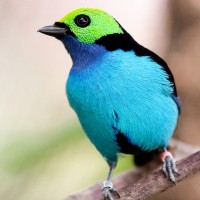
This bird doesn't merely wear bright colors—it wears perfection.
An impossibly turquoise head. A velvety black face. A lime-green back. Sky-blue underparts. Fiery red rump. Tiny flashes of yellow. Every feather seems carefully placed by an artist who refused to compromise.
The astonishing part isn't that it has so many colors.
It's that every single one belongs exactly where it is.
Many colorful birds feel flamboyant.
The Paradise Tanager feels... elegant.
You don't look at it and think, "That's a rainbow." You think, "That's art."
Found in the Amazon Basin, this little masterpiece spends much of its life foraging high in the rainforest canopy, often traveling with mixed-species feeding flocks. Spotting one means craning your neck toward the treetops—until suddenly a tiny jewel appears among the leaves, and for a few unforgettable seconds the forest seems to have invented a new color palette.
It also has one of the greatest names in ornithology.
Paradise Tanager.
No exaggeration.
No marketing.
Just an honest description.
Could the Painted Bunting rival it? Absolutely. Could the Seven-colored Tanager claim to be even flashier? You could make that argument too. And if your heart belongs to the Northern Cardinal, no ranking will ever change that.
But when beauty, balance, rarity, elegance, and sheer visual impact are all considered together...
The Paradise Tanager stands alone.
It is the bird that makes seasoned birders laugh out loud the first time they see it.
It is the bird that makes people wonder whether nature accidentally revealed the concept art instead of the final draft.
And for that reason, it claims the crown.... read more
-
Painted Bunting
The Bird That Looks Like a Box of Crayons Became Sentient
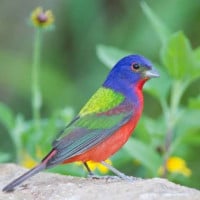
The Painted Bunting is what happens when a bird asks for all the colors and somehow pulls it off.
Blue head. Green back. Red belly. Yellow highlights. A tiny beak. A cheerful little shape. It looks less like a real animal and more like something a child drew with zero restraint—and the child was correct.
But here's the thing: it isn't just flashy. It's beautiful in a deeply satisfying way. The colors are bold, but they're arranged like a masterpiece. It has chaos, but designer chaos. It's the rainbow goblin prince of southern thickets.
And then the female deserves her own applause. She's not dull at all—she's a glowing green jewel, one of the prettiest female songbirds in North America. If the male looks like a tropical festival, the female looks like a fresh lime leaf came alive and started singing.
They can be surprisingly hard to see despite looking like a pride parade with wings. Painted Buntings often skulk in dense brush, where they sing from cover and make birders mutter things like, "I swear it was right there."
When one finally pops into view, though?
Game over.
You understand immediately why people lose their minds over this bird.
Fun Fact: Male Painted Buntings do not get their full rainbow adult plumage until their second year. First-year males are green like females, meaning there are undercover little chaos goblins walking around before unlocking their final boss outfit.
-
Indigo Bunting
The Blue That Doesn't Exist
The Indigo Bunting may be the most underrated beautiful bird in North America.
People see photos and think, "That's a nice blue bird."
Then they see one in person.
And suddenly the rankings get very complicated.
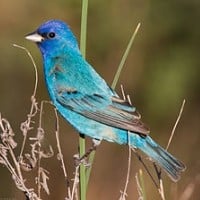
The male's feathers aren't actually blue.
There is no blue pigment in them whatsoever. Instead, microscopic structures in the feathers scatter sunlight so that only blue wavelengths reach your eyes. As the bird moves through the sunlight, it seems to shimmer between deep sapphire, electric cobalt, and brilliant turquoise, almost glowing from within.
Pictures simply don't do it justice.
If your birding life consists mostly of eastern North America, seeing your first Indigo Bunting is one of those moments that sticks with you. It doesn't matter how many cardinals, bluebirds, or goldfinches you've seen—the indigo seems almost unreal, like someone dropped a tropical jewel into an old country field.
And that's the beauty of it.
Unlike many dazzling tropical birds hidden in remote rainforests, Indigo Buntings happily breed along roadsides, woodland edges, overgrown fields, and brushy clearings. They're accessible enough that almost anyone can find one with a little patience, yet breathtaking enough that even experienced birders stop and stare.
Its cheerful, bouncy song fits the personality perfectly. Males spend the breeding season singing from exposed treetops and fence posts, announcing that this patch of countryside is very much taken.
If you've been fortunate enough to bird in Brazil or Papua New Guinea, you may have seen species that surpass it in sheer extravagance.
But for the rest of us?
The Indigo Bunting is a genuine contender for the most beautiful bird we've ever laid eyes on.... read more
-
Seven-Colored Tanager
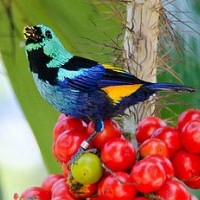
When Evolution Refused to Pick a Favorite Color
Some birds have beautiful plumage.
The Seven-colored Tanager has a complete paint set.
Seriously, this bird looks less like something that evolved naturally and more like a child's coloring book after someone gleefully ignored every instruction to "stay inside the lines."
Turquoise head? Check.
Emerald-green back? Absolutely.
Golden shoulders? Of course.
Crimson rump? Why not?
Black wings, cream underparts, flashes of blue everywhere... somehow, against all odds, none of it clashes. It isn't chaotic—it is harmonious, as though nature spent millions of years perfecting a color palette that artists still envy.
Found in the lush Atlantic Forest of eastern Brazil, the Seven-colored Tanager is one of the crown jewels of South American birding. Spotting one is the kind of experience that leaves even seasoned birders grinning like they just found treasure.
And unlike some brilliantly colored birds that only show their best side in perfect lighting, this species seems to glow from almost every angle.
One of the most surprising things about it is its size. For all that visual grandeur, it's only about five inches (13 cm) long—a tiny jewel flitting through the canopy. Imagine compressing an entire rainbow into something smaller than a sparrow.
Its voice, fittingly, is modest. The Seven-colored Tanager doesn't need a show-stopping song when it's already wearing the greatest outfit in the forest.
If this ranking were based only on appearance, there would be a very serious argument for putting it at number one.
But our list celebrates more than beauty alone.
Fun Fact: Despite the name, birders have jokingly pointed out that the Seven-colored Tanager seems to have more than seven colors. The name is less a precise count than an admission that whoever first described it gave up halfway through.
-
Northern Cardinal
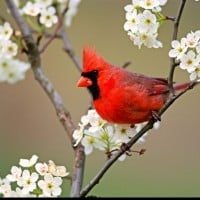
The northern cardinal (Cardinalis cardinalis) is a North American bird in the genus Cardinalis. It is also known as the redbird, red cardinal, or common cardinal. It inhabits southeastern Canada and much of the eastern United States, with its range extending west into parts of the southwestern United... read more
The King of the Backyard
Some birds earn their reputation through rarity.
The Northern Cardinal earns it simply by showing up.
No matter how many times you've seen one, the moment that brilliant crimson figure lands on a snowy branch, a dogwood, or your feeder, you stop what you're doing for just a second. It's one of those birds that somehow never becomes ordinary.
Its design is timeless.
A blazing red body. A proud crest that rises with every emotion. A bold black mask that somehow makes it look both noble and mildly judgmental. Add in a stout orange bill and you've got one of the most instantly recognizable birds on Earth.
The female deserves just as much appreciation. Rather than being a "duller version," she's beautifully dressed in warm browns accented with soft reds on the wings, tail, and crest. Together they may be one of North America's most handsome couples.
And then there's the song.
Unlike some birds that hide in the canopy, the cardinal announces itself from rooftops, treetops, and fence posts with loud, rich whistles that carry across neighborhoods year-round. Even people who don't know birds often know that sound.
They're also fiercely devoted to their territories and mates. Cardinals commonly form long-term pair bonds, and you'll often see the male bringing seeds to the female in a touching courtship ritual that looks remarkably like a little kiss.
For many people, though, the Northern Cardinal is more than just another bird.
It's their bird.
It's the first colorful species they learned as a child. The faithful visitor that appears every winter. The familiar face that greets them every morning at the feeder. It doesn't need to be the rarest or the flashiest because it's become part of people's lives.
Could some tropical tanagers outshine it in sheer color?
Perhaps.
Could any of them replace what the Northern Cardinal means to millions of bird lovers?... read more
-
Summer Tanager
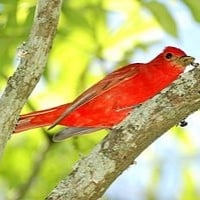
The Bee-Eating Crimson Gentleman
If the Scarlet Tanager is flashy, the Summer Tanager is refined.
Instead of the dramatic black-and-red tuxedo, the male Summer Tanager goes all in on one color. Every feather is a warm, rosy crimson, making it look less like a bird and more like a tiny feathered ruby drifting through the treetops.
It's simple.
It's elegant.
It works.
While Scarlet Tanagers often remain frustratingly high in the canopy, Summer Tanagers seem a bit more relaxed around people. They favor open woodlands, forest edges, river bottoms, and parks across the southern United States, where their rich, rolling song is often the first clue that one is nearby.
But this bird's greatest claim to fame isn't its color.
It's what it eats.
Summer Tanagers have earned the nickname "the beekeeper's friend" because they're remarkably fond of bees and wasps. They'll dart into the air, snatch one with surprising precision, then return to a perch and repeatedly smack it against a branch before carefully rubbing off the stinger. Only then do they enjoy their spicy little snack.
That's not bravery.
That's professionalism.
The females deserve some appreciation too. Rather than bright red, they're cloaked in rich mustard-yellow and olive tones, giving them a warm, golden appearance that many birders find just as beautiful in a quieter way.
And unlike many brilliantly colored birds whose songs are merely acceptable, the Summer Tanager delivers a genuinely pleasant performance—a rich, robin-like melody that fits its gentle personality.
Fun Fact: Summer Tanagers are the only completely red bird native to mainland North America. Unlike cardinals, whose faces and wings include black and gray, an adult male Summer Tanager is essentially red from bill to tail.
-
Scarlet Tanager
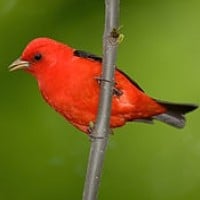
Some birds hide in plain sight.
The Scarlet Tanager does the exact opposite.
Imagine taking the brightest shade of scarlet imaginable, attaching two velvet-black wings, and then placing the bird high in the leafy canopy where somehow it becomes... incredibly difficult to find anyway.
Seriously. One of birding's great mysteries is how something this absurdly red can disappear twenty feet above your head.
The male Scarlet Tanager is one of North America's most iconic songbirds. Against the deep greens of an eastern hardwood forest, it practically glows. It's no surprise that generations of birders have described seeing one for the first time as unforgettable.
Then it sings.
Let's just say... the visual department and the music department did not coordinate budgets.
Its song is often compared to a slightly hoarse robin, as if a American Robin woke up with seasonal allergies and decided to keep performing anyway. It's perfectly respectable—but when you're dressed like that, people expect a Broadway solo.
Scarlet Tanagers spend much of their lives high in mature forests, quietly plucking caterpillars, beetles, and other insects from leaves. During migration they'll occasionally drop lower, giving lucky observers a spectacular view before vanishing back into the canopy.
And then there's autumn.
The brilliant males molt into a greenish-yellow plumage that makes them look almost like an entirely different species. It's one of the most dramatic seasonal wardrobe changes in the bird world.
Fun Fact: Despite the name, the female isn't scarlet at all. She's a lovely olive-yellow, providing excellent camouflage while nesting. By late summer, even the males trade their famous red suit for similarly subdued colors before heading to tropical wintering grounds.
-
Rose-Breasted Grosbeak
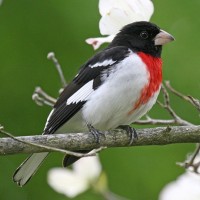
"Wait... that's not a tanager!"
Correct!
The Rose-breasted Grosbeak actually belongs to the Cardinalidae—the cardinal family—rather than the tanagers. But if there were ever a bird that deserved an honorary invitation to the tanager party, it's this masterpiece.
One look explains why.
The male is breathtaking: a crisp black-and-white tuxedo topped with a vivid triangular splash of rose-red across the chest, as though someone accidentally spilled raspberry paint on a formal suit and decided it looked fantastic.
It's bold without being gaudy.
Elegant without being plain.
And unlike some spectacular-looking birds...
...it can sing.
The Rose-breasted Grosbeak has one of North America's finest songs—a rich, flowing melody often described as an American Robin that took professional voice lessons. If the Scarlet Tanager spent its budget on wardrobe, the grosbeak somehow found enough left over for a world-class soundtrack.
They're also delightfully easygoing visitors. During migration they're happy to stop by backyard feeders for sunflower seeds, often lingering long enough for everyone to admire them. Unlike birds that vanish the instant you raise your binoculars, a grosbeak often seems perfectly content to pose.
The female deserves praise too. Instead of flashy colors, she wears beautifully patterned browns and buffs with a bold striped face. She resembles an oversized sparrow at first glance, but the massive silver bill gives her away.
Speaking of that bill...
"Grosbeak" literally means "large beak," and it lives up to the name. Those thick jaws make short work of hard seeds, but they're equally happy eating insects, berries, and even the occasional caterpillar.... read more
-
Western Tanager
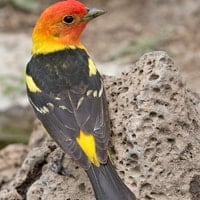
The Bird That Looks Like It Flew Through Wet Paint
If someone described a bird with a bright yellow body, jet-black wings, and a flaming red-orange head, you'd probably assume they were exaggerating.
Then the Western Tanager lands in front of you.
This western North American gem looks almost tropical, yet it spends much of the breeding season high in conifer forests from the Rockies to the Pacific Coast. It often stays in the canopy, where birders spend several minutes asking, "Was that a leaf... or was that—OH MY GOSH!"
Its coloration is wonderfully balanced. Unlike some birds that seem to have every color imaginable thrown together, the Western Tanager somehow makes yellow, black, white, and brilliant red look effortlessly classy. It resembles a living sunset wearing a tuxedo.
One of the coolest facts about the species is that the males can't actually make their own red pigment. Instead, they obtain yellow pigments from their diet and chemically transform them into the fiery orange-red feathers on their heads. In other words, they're nature's own little feather chemists.
Despite the dazzling appearance, they're surprisingly mellow birds. During migration they quietly work their way through forests and neighborhoods, picking insects from leaves before switching to berries later in the season. If you're lucky, one may briefly visit a backyard feeder with fruit.
They're also among those birds that make eastern birders just a little jealous. Spotting one out West feels almost routine; seeing one in the East causes bird alerts, excited phone calls, and optics pointed skyward.
Fun Fact: Unlike the brilliantly colored male, the female is mostly olive-yellow with grayish wings. She's subtler—but still unmistakably elegant.
-
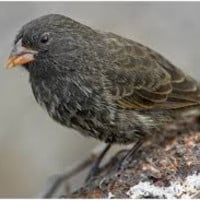
Small Ground Finch
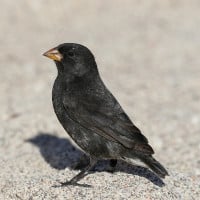
The Bird That Accidentally Changed Biology Forever
Not every legendary bird wears a rainbow.
The Small Ground Finch is, at first glance, almost aggressively ordinary. Brown? Check. Small? Check. Looks vaguely like the sparrows raiding your feeder? Also check.
And yet this humble little bird helped overturn humanity's understanding of life itself.
While visiting the Galápagos Islands in 1835, Charles Darwin collected several finches, including birds now recognized as the Small Ground Finch. Their subtly different beaks—each adapted to different foods—became one of the key observations that later contributed to his theory of evolution by natural selection. Few birds have had such an outsized impact on science.
Nowadays it's one of the most common birds visitors encounter on the islands. It hops around volcanic rocks, villages, beaches, and trails with complete confidence, cracking seeds with its stout little bill while acting as if being one of the most historically important birds on Earth is just another Tuesday.
Personality-wise, it's delightfully scrappy. Small Ground Finches are curious, bold around people, and always seem to be evaluating whether whatever you're holding might be edible.
No, it won't win a beauty contest against a Seven-colored Tanager.
But if birds received Nobel Prizes, this little seed-cracker would already have a shelf full of them.
Fun Fact: The Small Ground Finch is one of the famous "Darwin's finches." Despite the name, these birds are actually members of the tanager family (Thraupidae), not the true finch family. Genetics revealed that Darwin's iconic finches are really specialized tanagers that evolved into dozens of forms on the Galápagos—a wonderful reminder that appearances can be deceiving.
-
Medium Ground Finch
-
Vampire Ground Finch