Top Ten Best Warblers
Warblers are tiny birds with enormous personalities.
Most weigh less than half an ounce, yet many migrate thousands of miles every year, traveling between North America and the tropics with astonishing endurance. During spring migration, forests seem to come alive as these colorful sprites fill the canopy with movement and song. To birders, spotting a new warbler is equal parts excitement, frustration, and celebration, because many refuse to sit still for more than two seconds.
The family includes more than 50 regularly occurring species in North America, ranging from brilliant yellow and orange jewels to subtly beautiful olive-green specialists. Some spend their lives high in treetops, others stalk the forest floor, while a few splash through streams or haunt shadowy swamps. Despite their diversity, nearly all share an energetic, insect-hunting lifestyle.
Every birder eventually develops favorite warblers. Some earn their place through dazzling colors, others through funny behavior, memorable songs, or simply because they have delightfully ridiculous nicknames. (Looking at you, Butterbutt.)
So, without claiming scientific objectivity, and with full awareness that every birder's ranking is different, here are my ten favorite warblers and the reasons they've won me over.
-
Blackburnian Warbler
Every list needs one winner.
And if we're trying to be as objective as possible—not just picking favorites—the Blackburnian Warbler has one of the strongest claims to the crown.
Because...
Have you SEEN its face?
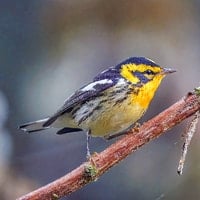
It looks like someone accidentally dipped a warbler into molten lava.
That blazing orange throat isn't just bright—it's absurdly bright. In good morning light, the bird practically glows. Many first-time birders assume their binoculars are oversaturating the colors.
Nope.
That's just what it looks like.
The rest of the bird is equally elegant: crisp black-and-white stripes, bold wing bars, and a tiny body carrying what may be the most spectacular plumage of any North American warbler.
Of course, nature couldn't make it too easy.
Blackburnians have an annoying habit of spending much of their time high in the tops of towering conifers, where they force birders into the ancient ritual known as The Warbler Neck Stretch™. You spot a flash of orange 80 feet overhead, spend five minutes trying to focus through branches, and emerge with a life bird... and a chiropractor appointment.
Despite that, almost everyone agrees on one thing:
When a Blackburnian Warbler finally comes into full view, the reaction is usually the same.
"Whoa."
Not "That's neat."
Not "Pretty bird."
Just...
"WHOA."
There are many wonderful warblers. Some are funnier. Some are rarer. Some have better nicknames.
But if you asked birders to vote for the most breathtaking warbler in North America, the Blackburnian would almost certainly finish near the very top.
-
Connecticut Warbler
The Connecticut Warbler is birding's version of Bigfoot.
Everyone agrees it exists.
Most people have never actually seen one.
Despite the name, it doesn't even breed in Connecticut. Early naturalists happened to collect one there during migration, shrugged, and accidentally saddled it with one of ornithology's most misleading names. Somewhere, the Louisiana Waterthrush nodded in approval.
This bird has mastered the ancient art of appearing exactly where you aren't looking.
You'll hear birders say things like:
"I had one for about three seconds."
Or:
"It popped out. right after I put my binoculars down."
Or the classic:
"You'll never believe this, but it was standing in the open!"
No one believes that last person.
Unlike many warblers that bounce around treetops, the Connecticut Warbler prefers quietly walking through thick undergrowth, almost like a tiny rail wearing warbler cosplay. It strolls with surprising confidence, bobbing through leaf litter while everyone else is craning their necks toward the canopy.
When you finally do get a good look, it's worth every mosquito bite.
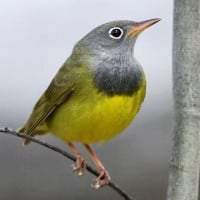
A crisp white eye-ring, smooth gray hood, warm yellow underparts, and an expression that somehow manages to look both curious and mildly judgmental.
It's not the flashiest warbler.
It isn't the loudest.
It certainly isn't the easiest.
But every birder remembers their first Connecticut Warbler because it feels less like spotting a bird.
And more like being granted a brief audience with a woodland celebrity that immediately vanishes before anyone else can see it.
Some birds are famous because they're beautiful.
-
Yellow-Rumped Warbler
Every birding family has that one cousin who gets away with everything.
Meet the Butterbutt.
Officially known as the Yellow-rumped Warbler, this bird has one claim to fame that completely overshadows its perfectly respectable scientific name:
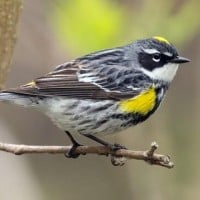
It has a bright yellow butt.
Birders saw this... and collectively decided, "Yep. Butterbutt it is." Decades later, the nickname remains undefeated.
The funny thing is, that's far from its only talent.
While most warblers throw a fit the moment autumn arrives and immediately head for the tropics, Butterbutt basically shrugs and says, "Nah, I'm good."
It's one of the hardiest warblers in North America because it can digest waxy berries like wax myrtle and bayberry—something most other warblers can't manage. That means it can stick around much farther north in winter while its relatives are already sipping tiny insect smoothies in the Caribbean.
It's also one of the first warblers many people learn to identify. Gray back. White throat. Yellow patches on the sides. Yellow crown. And, of course...
The Butt.
You'll spend five minutes carefully studying wing bars and facial patterns...
...only to realize you could have just waited for it to turn around.
Despite being common, Butterbutts never get old. They're energetic, handsome, adaptable, and somehow manage to make thousands of birders smile every spring simply by flashing their most famous field mark.
Let's be honest.
If evolution gives you a built-in yellow highlighter on your rear end...
-
Pine Warbler
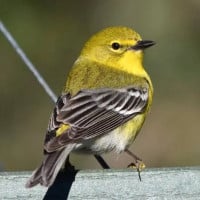
The Pine Warbler has absolutely nothing to prove.
While other warblers are sprinting through the canopy like they're late for an important meeting, the Pine Warbler is perfectly content to sit on a branch, sing a pleasant little tune, and enjoy the view.
It's the laid-back uncle of the warbler family.
As the name suggests, it loves pine trees. If you're standing in a pine forest and hear a slow, musical trill drifting from above, there's a good chance a Pine Warbler is quietly supervising the neighborhood.
And unlike many of its hyperactive cousins, this bird often gives birders a break. It actually sits still. Imagine that! You can raise your binoculars, admire it, maybe even take a photo, and it's still there instead of teleporting behind seventeen leaves.
Its plumage won't stop traffic. Olive-green above, yellowish below, with a gentle expression that somehow makes it look permanently polite. It's the kind of bird that never demands attention—but always earns it.
The Pine Warbler is also one of the few warblers that regularly visits backyard feeders. Offer sunflower hearts, suet, or mealworms, and there's a chance this forest specialist will decide your yard is worth adding to its itinerary.
It doesn't need blazing orange feathers or a dramatic life story.
It wins people over the old-fashioned way:
By being consistently pleasant, wonderfully cooperative, and making every pine forest feel just a little more peaceful.
-
Kirtland's Warbler
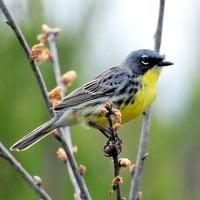
Some birds are rare because they're hard to find.
The Kirtland's Warbler looked at that idea and said, "Hold my pine tree."
For decades, this was one of North America's rarest songbirds. If you wanted to see one, you basically had to visit a very specific part of Michigan where young jack pine forests had grown to just the right age. Too young? Nope. Too old? Also nope. Goldilocks would have approved.
Its pickiness nearly drove it to extinction.
Then conservationists, foresters, and volunteers stepped in. They managed forests, controlled Brown-headed Cowbird populations, protected breeding habitat, and slowly—but surely—brought the species back from the brink.
Today, the Kirtland's Warbler stands as one of the greatest conservation success stories in American birding.
And the bird itself?
It's charmingly handsome without trying too hard. Blue-gray above, sunny yellow below, bold white eye-rings that make it look permanently surprised, and a cheerful song that carries across the pines.
Seeing one isn't just another life bird.
It's seeing decades of dedicated conservation literally singing back at you.
Every Kirtland's Warbler you encounter is a reminder that extinction isn't always inevitable. Sometimes, with enough patience, science, and determination, nature gets a second chance.
That's a pretty remarkable legacy for a bird that weighs less than half an ounce. 🌲💙💛
-
American Redstart
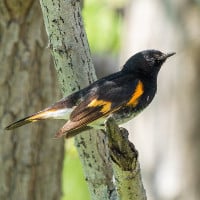
Imagine giving a toddler three espressos, a jetpack, and a cape.
Congratulations—you've invented the American Redstart.
This bird simply does not have an idle mode. It's constantly darting from branch to branch, fanning its tail, flashing bright orange patches, and changing directions so quickly that your binoculars become little more than expensive decorations.
The flashy colors aren't just for showing off, either. Those bold orange (or yellow, on females and young birds) patches help flush insects from leaves. The startled bugs take flight... and the Redstart is already there to snatch them out of the air. It's less a bird than a tiny aerial ambush predator.
Watching one is like trying to photograph a feather with ADHD.
The males are especially striking, dressed in sleek black with brilliant orange patches that seem to glow every time they spread their wings. Females trade the black for soft gray and the orange for yellow, proving that the species looks good in every outfit.
Finding one during migration is always a delight. Photographing one? That's another matter entirely.
By the time you've focused your camera, it's already visited three branches, caught two insects, wagged its tail six times, and is halfway to the next tree.
The American Redstart doesn't believe in standing still.
It believes in making sure every birder earns the sighting.
-
Prothonotary Warbler
-
Yellow Warbler
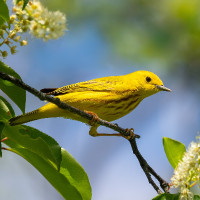
If someone handed a child a crayon and said, "Draw a warbler," they'd probably end up with a Yellow Warbler.
It's the default setting.
Bright yellow from head to tail, cheerful beyond reason, and somehow always looking like it just heard the best joke in the forest.
Unlike some of its more dramatic relatives that insist on hiding behind seventeen layers of leaves, the Yellow Warbler is surprisingly cooperative. It'll perch out in the open, sing its heart out, and basically announce, "Yes, I'm the bird you came to see."
Its sweet, rapid song is often translated as:
"Sweet, sweet, sweet... I'm so sweet!"
Which, honestly, is exactly the kind of confidence you'd expect from a bird that looks like it flew through a bucket of sunshine.
Yellow Warblers also have one of the coolest survival stories in the bird world. They are frequent targets of the Brown-headed Cowbird, which sneaks its eggs into other birds' nests. Rather than simply giving up, Yellow Warblers sometimes build an entirely new floor over the unwanted egg, creating a second story in the nest and leaving the intruder buried beneath. It's the avian equivalent of saying, "We're renovating. You weren't invited."
Friendly, colorful, common enough to brighten almost any spring walk, yet still exciting every single time you see one—the Yellow Warbler is a classic for a reason.
Sometimes the most iconic choice is iconic because it deserves to be. ☀️🐦
-
Ovenbird
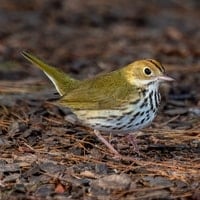
At first glance, the Ovenbird is... well... aggressively average.
Brown? Check.
Striped? Check.
Looks like it was assembled from leftover sparrow parts? Also check.
Then it opens its beak.
"TEACHER! TEACHER! TEACHER!"
Suddenly, this tiny woodland potato is the loudest thing in the entire forest.
Unlike most warblers, which spend their lives bouncing around the treetops making birders develop neck problems, the Ovenbird struts around the forest floor like it owns the place. It walks instead of hopping, flipping leaves aside in search of insects with all the seriousness of a detective investigating a crime scene.
Its name doesn't come from looking like an oven—it comes from its remarkable nest. The female builds a domed nest on the ground with a side entrance that early naturalists thought resembled an old-fashioned outdoor baking oven.
The result is one of North America's most distinctive songbirds: plain enough that you might overlook it, but unforgettable once you hear it shouting its profession at everyone within half a mile.
It's proof that you don't need flashy colors to become a birding legend. Sometimes all you need is confidence, good acoustics, and a complete inability to use your indoor voice.
-
Louisiana Waterthrush
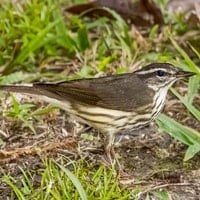
If you had one job—and that job was to confuse beginning birders—you'd invent the Louisiana Waterthrush.
First, it isn't from only Louisiana. Second, it isn't a thrush. It's a warbler. Whoever named this bird clearly woke up and chose misinformation.
Instead of flitting through the treetops like most of its relatives, this little oddball patrols woodland streams with the confidence of a tiny park ranger. It constantly bobs its tail, marches over rocks, and inspects every inch of the creek as if conducting a federal water-quality survey.
Its song is just as memorable: a loud, ringing burst that echoes through ravines long before you ever spot the bird itself. You hear it and think, "That has to be something important." Then you finally find... a bird about the size of a potato chip.
Despite the identity crisis, it's an absolute gem. If you find a clean, shaded forest stream, there's a decent chance this feathered fraud is somewhere nearby, wagging its tail and pretending the entire creek belongs to it.
Rating: ★★★★☆ for beauty. ★★★★★ for trolling everyone who learns bird names.
-
?
Black-and-White Warbler
-
?
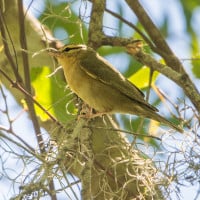
Worm-Eating Warbler
-
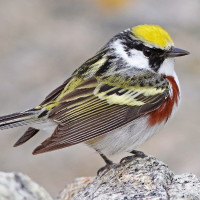
Chestnut-Sided Warbler
-
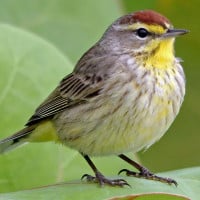
Palm Warbler
-
Swainson's Warbler