Top 10 Facts About Saber-Toothed Cats
Saber-toothed cats are a well-known group of prehistoric mammals from the Ice Age. They are already fascinating, but they become even more interesting once we get to know them better.
-
They likely ate human ancestors
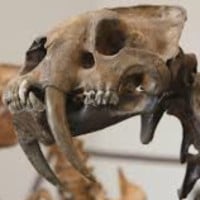
Two holes on a 1.75-million-year-old hominid skull from the Republic of Georgia perfectly match the elongated canines of either the lion-sized Homotherium or its smaller cousin, Megantereon.
-
Most species fell into two main categories
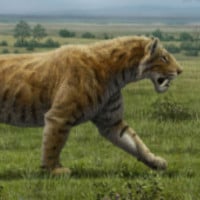
The machairodonts comprise an extinct subfamily that includes the majority of saber-toothed felines. Using a few anatomical details, scientists have identified two primary subgroups: scimitar-toothed cats like Homotherium, which were likely agile hunters with broad, shorter canines, and dirk-tooths like Smilodon, which had long, thin fangs and heavyset bodies.
But some machairodonts aren't easily categorized. Xenosmilus, an extinct genus of Homotherium from the early Pleistocene, for example, displayed both scimitar canines and the squat, muscular legs of a dirk-tooth.
-
At least one species appears to have been social
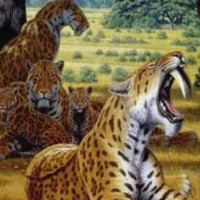
The remains of 19 adult Homotherium and 13 juveniles were found in Texas's Friesenhahn Cave, along with upwards of 300 milk teeth from young mammoths. Scientists theorize that the cave was home to a pride that dragged elephantine herbivores back to eat.
-
The most famous saber-toothed cat, Smilodon fatalis, was likely a weak biter
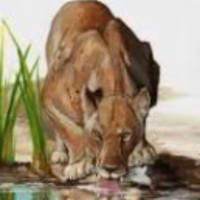
A study revealed that Smilodon fatalis could only chomp down with one-third of the force that lions exert today. "For all its reputation, Smilodon had a wimpy bite."
Although it had a weak bite, Smilodon's jaws were capable of opening at an astounding 120-degree angle. By comparison, a lion's jaws max out at 60 degrees.
-
Thousands of Smilodon bones were found at the La Brea Tar Pits
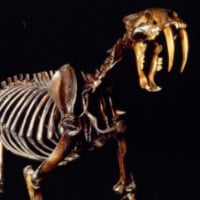
The La Brea Tar Pits have yielded more than 130,000 Smilodon bones, and counting, which represent at least 2,000 individual animals.
-
They likely lived alongside non-saber-toothed cats
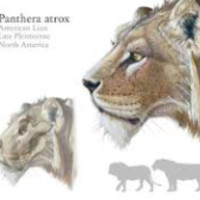
During the last Ice Age, Smilodon had to compete with Panthera leo atrox, or the American Lion, a huge animal that was about 25 percent bigger than its modern-day namesake. The lynx and pumas we all know today were also around at the time, as was a speedy, cheetah-like predator called Miracinonyx.
-
Saber-toothed cats were likely ambush predators
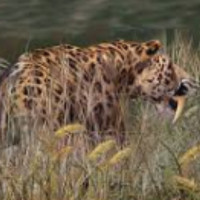
Their short, stocky legs and small lung capacity suggest that these cats were likely ambush hunters like most other cat species today.
-
The largest known species of saber-toothed cat, Smilodon populator, belonged to the Smilodon genus
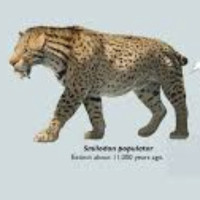
It could weigh up to 436 kilograms (961 lbs), with some individuals estimated to be even larger, and had exceptionally long canine teeth that could reach up to 28 centimeters.
-
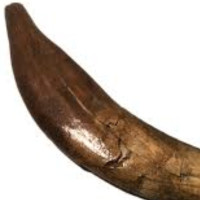
Saber-toothed tiger teeth can be as long as an adult human's hand
-
Sabre-toothed cats roamed North America and Europe throughout the Miocene and Pliocene epochs
-
Smilodon gracilis was the smallest species in the Smilodon genus
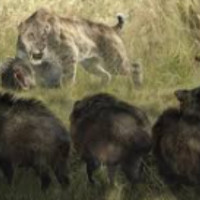
It was roughly the size of a modern-day jaguar, weighing an estimated 55 to 100 kg (120 to 220 lb).
-
Saber-toothed tigers were not actually tigers
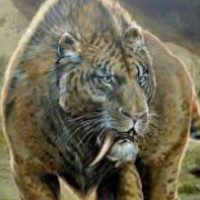
All modern tigers are subspecies of Panthera tigris (for example, the Siberian tiger is technically known by the genus and species name Panthera tigris altaica). What most people refer to as the saber-toothed tiger was actually a species of prehistoric cat known as Smilodon fatalis, which was only distantly related to modern lions, tigers, and cheetahs.