Top 10 Most Important People of Ancient Greece
-
Socrates
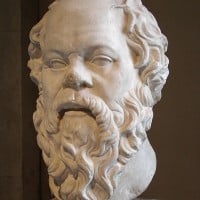
Socrates was a classical Greek philosopher known for his contributions to ethics and epistemology. He developed the Socratic method, a form of cooperative argumentative dialogue. He left no written works, and his ideas are primarily known through the writings of his students, including Plato. He was sentenced to death by drinking hemlock in 399 BCE.
-
Plato
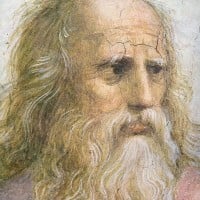
Plato was an ancient Greek philosopher and a student of Socrates. He founded the Academy in Athens, one of the earliest institutions of higher learning. His written dialogues explore topics such as justice, politics, and metaphysics. His most famous work, The Republic, outlines his vision of an ideal society.
-
Aristotle
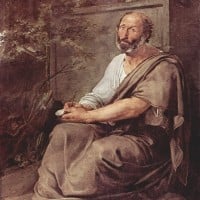
Aristotle was a Greek philosopher and scientist who studied under Plato. He made significant contributions to various fields, including logic, biology, and political theory. He tutored Alexander the Great and later founded the Lyceum in Athens. His works influenced both Islamic and Western intellectual traditions for centuries.
-
Alexander the Great
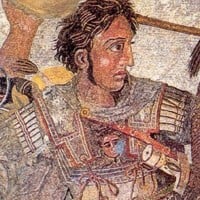
Alexander the Great was a Macedonian king who created one of the largest empires in history. He succeeded his father, King Philip II, and expanded his rule across Persia, Egypt, and parts of India. His military campaigns spread Greek culture and influence throughout the known world. He died in 323 BCE in Babylon under uncertain circumstances.
-
Homer
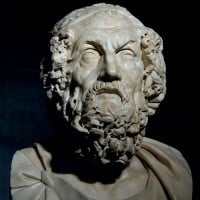
Homer was an ancient Greek poet traditionally credited with composing The Iliad and The Odyssey. His epics narrate events related to the Trojan War and its aftermath. His works played a central role in Greek education and literature. There is little concrete historical information about his life or identity.
-
Hippocrates
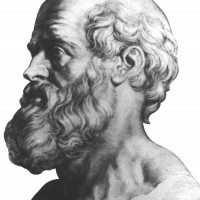
Hippocrates was an ancient Greek physician often referred to as the "Father of Medicine." He established a systematic approach to medical practice based on observation and diagnosis. The Hippocratic Oath, attributed to him, sets ethical standards for medical professionals. His teachings emphasized the natural causes of diseases rather than supernatural explanations.
-
Pythagoras
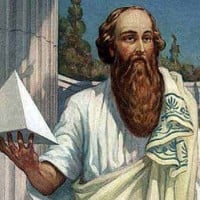
Pythagoras was an ancient Greek mathematician and philosopher known for his work in geometry. He founded a religious and philosophical school that believed in the relationship between numbers and the natural world. The Pythagorean Theorem, which describes the relationship between the sides of a right triangle, is named after him. His teachings also included ideas about the immortality of the soul and reincarnation.
-
Archimedes
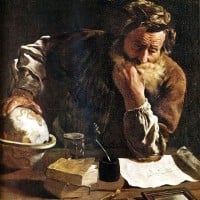
Archimedes was a Greek mathematician, physicist, and engineer from the city of Syracuse. He made advancements in geometry, calculus, and fluid mechanics. He is known for discovering the principle of buoyancy, now called Archimedes' Principle. His inventions included war machines used to defend Syracuse against the Romans.
-
Euclid
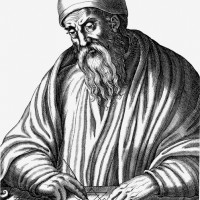
Euclid was an ancient Greek mathematician known as the "father of geometry." His work Elements is one of the most influential mathematical texts, establishing principles of geometry that remained standard for centuries. He lived in Alexandria during the reign of Ptolemy I, around the 3rd century BCE.
-
Pericles
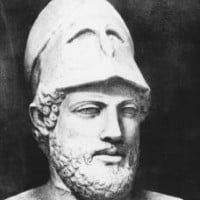
Pericles was an Athenian statesman who led Athens during its Golden Age. He promoted democracy, commissioned the construction of the Parthenon, and expanded the Athenian empire. His leadership helped develop Athens into a major cultural and political center of the ancient world. He died during the plague that struck Athens in 429 BCE.
-
?
Anaxagoras
-
?
Plutarch
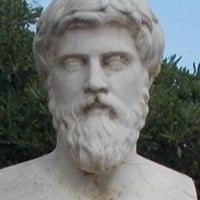
Plutarch was a Greek historian, biographer, and philosopher of the Roman era. He is best known for his work Parallel Lives, a series of biographies comparing Greek and Roman figures, and Moralia, a collection of essays on ethics and philosophy. His writings influenced later historians and political thinkers.
-
Sophocles
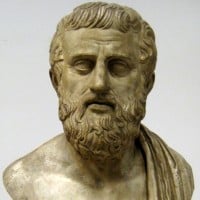
Sophocles was an ancient Greek playwright known for his contributions to tragedy. He wrote over 120 plays, though only seven survive in full. His most famous works include Oedipus Rex and Antigone. He introduced innovations such as the use of a third actor and developed character depth in Greek drama. He lived from around 497 to 406 BCE.
-
Euripides
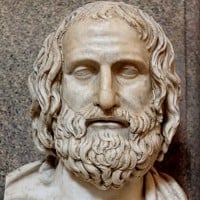
Euripides was a classical Greek tragedian who wrote numerous plays, with around 18 surviving in full. His works often focused on human psychology and featured strong female characters. Notable plays include Medea, The Bacchae, and Hippolytus. He lived from approximately 484 to 406 BCE.
-
Solon
Solon was an Athenian statesman and lawmaker credited with laying the foundation for democracy in Athens. In the early 6th century BCE, he enacted economic and political reforms that reduced debt slavery and restructured the government. His policies influenced later democratic developments in Greece.
-
Sappho
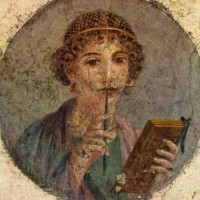
Sappho was an ancient Greek poet from the island of Lesbos, known for her lyric poetry that focused on themes of love and personal reflection. Much of her work was composed for musical performance and written in the Aeolic dialect. Only fragments of her poetry survive, with the exception of a few complete poems, including the "Ode to Aphrodite." She was highly regarded in antiquity and often referred to as the "Tenth Muse."
-
Herodotus
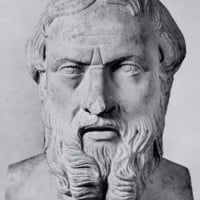
Herodotus was a Greek historian often called the "Father of History." He wrote The Histories, which detailed the Greco-Persian Wars and various cultural observations. His work combined historical narrative with myths, oral traditions, and geographical descriptions. His methods laid the foundation for historical writing in the Western world.
-
Aeschylus
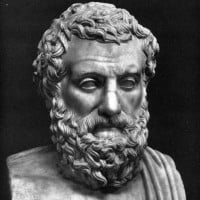
Aeschylus was an ancient Greek playwright and is considered the father of tragedy. He introduced the second actor to dramatic performances, expanding dialogue and plot complexity. His surviving works include The Oresteia trilogy and The Persians. He lived from around 525 to 456 BCE.
-
Aesop
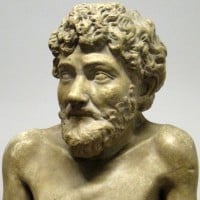
Aesop was an ancient Greek storyteller traditionally credited with composing fables that feature animals and moral lessons. His works, collectively known as Aesop's Fables, include well-known stories such as The Tortoise and the Hare and The Boy Who Cried Wolf. His historical existence remains uncertain, with accounts placing him in the 6th century BCE.
-
Draco
Draco was an Athenian lawmaker known for creating one of the earliest written legal codes in Greece. His laws, established in the 7th century BCE, were noted for their harshness, with the death penalty prescribed for many offenses. His legal system influenced later Athenian reforms.
-
Demosthenes
Demosthenes was an Athenian statesman and orator of the 4th century BCE. He is known for his speeches opposing Macedonian expansion under Philip II. His Philippics and other orations are key examples of classical rhetoric. He died in 322 BCE after being pursued by Macedonian forces.
-
Cleisthenes
Cleisthenes was an Athenian statesman who implemented democratic reforms in the late 6th century BCE. He reorganized the political structure of Athens by creating new tribes and the Council of 500, increasing citizen participation. His reforms helped shape the foundations of Athenian democracy.
-
Aristarchus
Aristarchus was an ancient Greek astronomer known for proposing a heliocentric model of the solar system, suggesting that the Earth orbits the Sun. His ideas, developed in the 3rd century BCE, were largely ignored in favor of the geocentric model until the Renaissance.
-
Pindar
Pindar was an ancient Greek lyric poet known for his victory odes, which celebrated athletic triumphs at events such as the Olympic and Pythian Games. His surviving works are among the best-preserved examples of choral lyric poetry. He employed complex metrical structures and was recognized for his use of grand style and mythological references. His poetry was highly valued in antiquity, and his house in Thebes was reportedly spared by Alexander the Great.
-
Hesiod
Hesiod was an ancient Greek poet often considered a major figure in early Greek literature. His most well-known works, Theogony and Works and Days, provide insights into mythology, cosmogony, and agricultural practices. Theogony outlines the origins of the gods, while Works and Days offers moral and practical guidance for rural life. He is sometimes credited with shaping early Greek thought alongside Homer.
-
Aristophanes
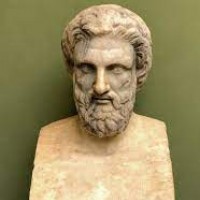
Aristophanes was an ancient Greek playwright known for his comedic plays that satirized Athenian society, politics, and intellectual trends. His works, including Lysistrata, The Clouds, and The Frogs, are among the best-preserved examples of Old Comedy. He often used humor, parody, and exaggerated characters to critique prominent figures such as Socrates and Cleon. His plays provide valuable insight into classical Athenian culture and politics.
-
Thales of Miletus
Thales of Miletus was a pre-Socratic philosopher and mathematician from Ionia. He is credited with advancing early Greek science and proposing that water was the fundamental substance of all matter. He is also recognized for contributions to geometry, including Thales' theorem. Ancient sources attribute the prediction of a solar eclipse to him.