Top 10 Best Historical Pirate Flags
Some pirate flags were pure nightmare fuel. Others were weirdly stylish, like if graphic designers had gone rogue in the 1700s. Skulls, hourglasses, bleeding hearts, dancing skeletons. These weren't just doodles. These were threats in fabric form. Each symbol carried a message. You're out of time. You're going to bleed. Or maybe, this guy just really liked bones. They were designed to terrify the crew of a ship into giving up without a fight. Spoiler alert: it sometimes worked.
This list focuses on actual pirate flags used by historical pirates. Not the movie props or fantasy versions with perfect symmetry and brand appeal. If you plan to add a flag, try to stick with those supported by historical documents or well-regarded research.
Vote for the flags that deserve to rise to the top. Maybe it's the one that scared merchant sailors into jumping overboard. Maybe it's the one that still looks hardcore centuries later. Whatever your reason, your vote helps sort the legendary from the forgettable.
-
Thomas Tew

"Thomas Tew"
Years active: 1692 - 1695.
The sword on a black background signifying violence or death was imminent, but there's no need for bloodshed if the victims "stand down". He was known to treat those who surrendered very well, even described as a kind man. You guys knew I would have this at number one, right?
-
Bartholomew Roberts (Version II)
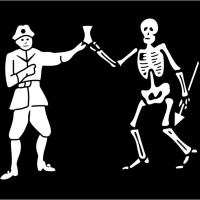
"Black Bart"
Years active: 1719 - 1722.
White pirate with a white skeleton holding an hourglass. It was to signify that time was running out for their victims.
This one is just crying out to be colored in.
-
Edward Teach (Blackbeard)
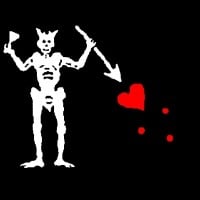
"Blackbeard"
Years active: 1716 - 1718.
Horned skeleton making a toast while pointing a spear at a heart dripping blood. His flag signifies a slow, painful death to his victims who don't surrender. He was known to commandeer ships using fear and intimidation rather than violent force.
-
Christopher Moody
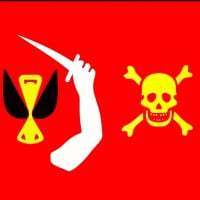
"Christopher Moody"
Years active: 1718 - 1722.
Violent psychopath. The flag represents that no lives will be spared on the ships he attacks. The hourglass with wings signifies that time is running out for the victims. The sword and skull on a red flag mean they're going to attack and kill everyone on the ship. However, there's a debate on if this is really his flag. Some say it is, some say it belonged to another pirate (possibly William Moody), and some say the flag is completely fictional.
-
Edward Low
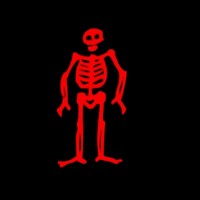
"Ned Low"
Years active: 1721 - 1724.
Described as brutal, a savage, and desperate. He was known to violently torture his victims before he murdered them. The red skeleton represents the evil and anger of the pirate crew, and a very violent bloody death was imminent for the victims.
-
Walter Kennedy
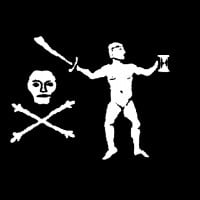
'Walter Kennedy"
Years active: 1718 - 1721.
Next to the somewhat traditional Jolly Roger was a naked pirate holding a sword in one hand and an hourglass in the other. The naked pirate represents that he has no shame and again, the sword and hourglass he's holding signifies violence is coming and the victim's time is running out. Word is this flag was also used by a pirate named Jean Thomas Dulaien.
-
Stede Bonnet
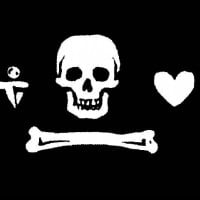
"The Gentleman"
Years active: 1717 -1718.
Rich man turned pirate. Like Thomas Tew, he was known to be polite and quite the gentleman to those who surrendered. The knife to the left signifies violence or death while the heart on the right represents life.
-
John Rackham (Calico Jack)
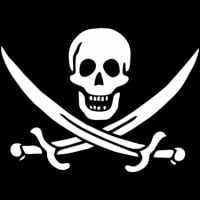
"Calico Jack"
Years active: 1718 - 1720.
He used the traditional "Jolly Roger" but replaced the crossbones with swords, signifying they are more than willing to get violent if the crew didn't surrender.
-
Jolly Roger
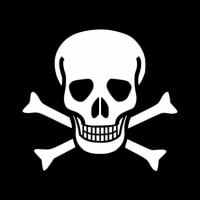
-
Bartholomew Roberts (Version I)
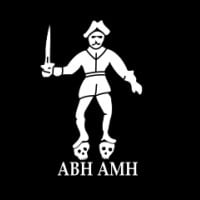
"Black Bart"
Years active: 1719 -1722.
This flag depicts him standing on two skulls with the initials ABH (A Barbadian's Head) and AMH (A Martiniquan's Head).
-
Henry Avery
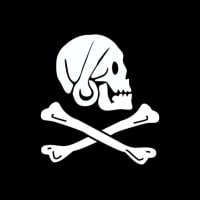
"Long Ben"
Years active 1694 - 1696.
He used the traditional "Jolly Roger" but turned the skull to the side and wearing a kerchief.