Top 10 Black Holes
When stars undergo nuclear fusion, it exerts an outward pressure that counteracts the force of gravity trying to push the star inward.
When a very massive star runs out of the fuel it needs for nuclear fusion, it can no longer maintain that pressure and goes supernova, spewing out its outer layers as the remaining core collapses into the most extreme type of object in the universe: a black hole.
A black hole is a point of no return, and once something crosses the event horizon, it can never go back. So far, we've discovered hundreds of black holes, and it's estimated that 100 million may lurk in the Milky Way alone.
-
Sagittarius A*
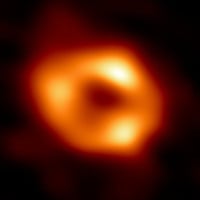
Sagittarius A* is a supermassive black hole with a mass of approximately 4.2 million solar masses at the center of the Milky Way Galaxy.
-
Messier 87*
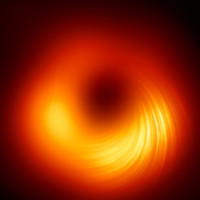
Messier 87* is a very massive supermassive black hole, estimated to be approximately 6.5 billion times the mass of our Sun. It was the first black hole to be directly imaged.
-
Cygnus X-1
Cygnus X-1 is a roughly 21-solar-mass stellar black hole in a binary system with a blue supergiant star. The system is about 7,000 light-years away and was the first object widely accepted to contain a black hole. It was discovered as an X-ray source in 1964 and became one of the most extensively studied black hole systems.
-
Gaia BH1
Gaia BH1 is a roughly 10-solar-mass stellar black hole in a binary system with a Sun-like star. At approximately 1,560 light-years away, it's the closest known black hole to Earth.
-
TON 618
TON 618 is an extremely massive supermassive black hole with an estimated mass of about 40 billion solar masses. Its light has taken approximately 10.8 billion years to reach Earth, while its present-day comoving distance is approximately 18 billion light-years.
-
Phoenix A*
Phoenix A* is a supermassive black hole with an uncertain mass that may be on the order of 100 billion times the mass of the Sun. Such an estimate would make it one of the most massive black holes ever proposed, although its mass has not been measured directly through orbital motion. It powers the active galactic nucleus at the center of Phoenix A, the central galaxy of the Phoenix Cluster.
-
M31*
M31* is a supermassive black hole at the center of the Andromeda Galaxy. Its mass is estimated to be about 200 million solar masses. Although it's a common misconception that black holes are the densest objects in the universe, this only applies to stellar-mass black holes. Based on its average density within the event horizon, M31* is less dense than water.
-
RX J1131-1231
RX J1131-1231 is a quasar containing a supermassive black hole about 6 billion light-years from Earth. In 2014, astronomers determined that X-rays were being emitted from very close to the black hole, which indicated that it was spinning at nearly half the speed of light. RX J1131-1231 was the first black hole to have its rotation directly measured in this way, and it's generally expected that most astrophysical black holes rotate.
-
Great Annihilator
The Great Annihilator is a microquasar that likely contains a stellar-mass black hole and a companion star. It has emitted large quantities of photons at an energy of 511 kiloelectronvolts, a signature associated with the annihilation of electron-positron pairs. Hence the name, the Great Annihilator.
-
Holmberg 15A