Top 10 Neutron Stars
Neutron stars occur when a very massive star is dying. The star can no longer maintain nuclear fusion inside it, which exerts force against the gravity of the star and stops it from collapsing.
With no way to resist its own gravity, the star goes supernova while its remaining dense core battles against gravity. Ultimately, the pressure of the densely packed neutrons inside the star's core is enough to resist its gravity, and it becomes an extremely dense, rapidly spinning, city-sized ball of matter called a neutron star.
-
Cosmic Cannonball
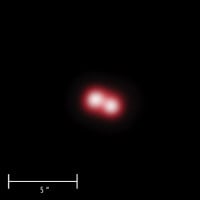
The Cosmic Cannonball is a radio-quiet neutron star about 2,000 parsecs away. It's rocketing away from the site of its supernova at a speed of 672 km/s, which is why it's called the Cosmic Cannonball.
It's a very interesting neutron star because no one knows what caused it to be going that fast. While other very fast stars' motion can be explained by a pass near the Milky Way's supermassive black hole, Sagittarius A, the Cosmic Cannonball's high speed remains completely unexplained.
-
Crab Pulsar
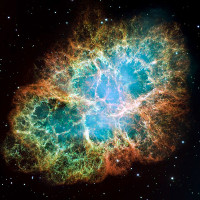
The Crab Pulsar is a spinning neutron star about 6,000 light years away. It is the remnant of a supernova explosion that was observed from Earth in the year 1054. That event was widely observed around the world and remained visible for two years.
The pulsar is also one of the few known neutron stars that emits visible light.
-
Vela Pulsar
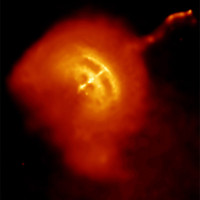
The Vela Pulsar is a pulsar only 959 light years away. It's also one of the brightest, emitting radio waves, X-rays, gamma rays, and visible light.
It's also the best known "glitching" pulsar. A glitching pulsar is one that suddenly increases its rotation speed. These glitches happen about every three years, but they aren't predictable. Vela was observed glitching live in 2016 by the Mount Pleasant Radio Telescope.
-
Lich
Like the undead fantastical creature that gave Lich its name, this quickly rotating neutron star is extremely powerful and interesting. Lich rotates 161 times per second, which is even faster than the blade of a blender.
It also has three orbiting planets, which were the first exoplanets ever discovered.
-
Black Widow pulsar
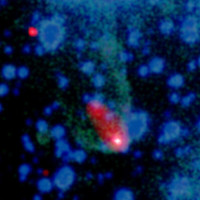
The Black Widow pulsar is a neutron star with a binary companion that's either a brown dwarf or a very large planet. The pulsar gets its name from the fact that it's slowly destroying its companion with powerful "winds" of high-energy particles.
It's also a very fast-spinning pulsar, rotating once every 1.6 milliseconds.
-
PSR J0737-3039
PSR J0737-3039 is a binary system made up of two neutron stars orbiting each other. It's the first known "double pulsar," which is a system of two pulsars in mutual orbit.
The two stars orbit each other every 2.4 hours.
-
3XMM J004232.1+411314
3XMM J004232.1+411314 is a pulsar in the Andromeda galaxy. It has a binary companion, which is a main-sequence, or "regular," star.
Since main-sequence stars mostly emit visible light and neutron stars mostly emit X-rays, they can dim each other in different wavelengths when one passes in front of the other as seen from Earth. 3XMM J004232.1+411314 is very bright, but it's not bright enough to overpower its companion. It's the brightest known neutron star that's still dimmed by its stellar companion.
-
Calvera
Calvera is a radio-quiet neutron star, which means it doesn't have pulsating jets shooting out of its poles. It was named after the villain in the film The Magnificent Seven because it was discovered after a famous group of seven other isolated neutron stars.
It's located less than 2,000 parsecs away.
-
RX J1856.5-3754
RX J1856.5-3754 is the closest observed neutron star to Earth, located about 400 light years away. It's part of the "Magnificent Seven" group of isolated, non-pulsing, young neutron stars.
RX J1856.5-3754 was formed in a supernova explosion roughly one million years ago.
-
Bursting Pulsar
The Bursting Pulsar is a neutron star that emits sudden bursts of gamma rays and X-rays. During an active outburst, it can emit up to 20 bursts per hour. After an outburst, it enters a quiescent phase where the bursts stop, which can sometimes last for nearly two decades.