Top 10 Best Racehorses of All Time
From legendary champions that rose from humble beginnings to breed icons, these horses are the ones whose strength, speed, and sheer will to win have left people in awe.
They've won impossible races, set records that still stand, and carved unforgettable moments into racing history.
-
Secretariat
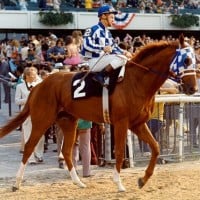
Secretariat, an American Thoroughbred racehorse, became a Triple Crown winner in 1973, setting records in all three events. Known for his exceptional speed and stamina, he is often regarded as one of the greatest racehorses of all time. His legacy continues to influence the horse racing world decades after his retirement.
Secretariat is simply the most magnificent Thoroughbred ever born. His three record-holding Triple Crown races attest to his utter dominance and permanent accolade as the GOAT of horse racing. Anyone denying his ranking as the all-time best is letting their feelings overrule the facts.
The fastest horse on dirt from 1 3/16 to 1 5/8 miles in history. Secretariat holds the still standing fastest recorded times in the world on dirt all the way from 1 3/16 to 1 5/8 miles in history, and is just 0.2 seconds off the current 1 1/8 mile world record. He NEVER lost a race that was not caused by ill health (x2), unprepared replacement for another horse in long distance race (x1), severe interference (x1) or unfair disqualification (x1). Excluding these factors, he won his remaining 16 races all by handsome margins of multiple lengths, never a photo finish. Under healthy and fair conditions, he would beat ANY horse put against him, not by a nose, but by a margin of lengths.
-
Man O' War
Often considered one of the greatest racehorses in history, Man O' War dominated American horse racing in the post World War I era. Winning 20 of 21 races, his only loss was to a horse named Upset. Man O' War's impressive size, speed, and spirit left a lasting legacy in the racing world.
For me, the only real way to compare and judge competitors from different eras in any athletic discipline is by how dominant they were. In that regard, Man O' War has no competition. He nearly made a mockery of the sport, and all his latest "races" were really just speed exhibitions.
By that point, no one wanted to send their best horses out to be so dominated. Moreover, all of this was achieved with some of the highest handicap weights ever assigned. He was retired at age 3 because, had he raced another year, he likely would've been sent to post with even higher weight assignments - the highest assigned weights of any racehorse in history to this day.
-
Seabiscuit
An American Thoroughbred, Seabiscuit became an icon during the Great Depression for his unexpected victories against larger, more imposing competitors. His underdog story, highlighted by a victory in the 1938 match race against War Admiral, inspired many. Seabiscuit's rags to riches tale remains a quintessential part of American horse racing folklore.
Seabiscuit, I think, should be the number one horse that ever lived because, unlike most of the horses on this list, they are born naturally big. Seabiscuit was the underdog before he showed the world what he was really made of. Despite his smaller size compared to his rivals at the time, he was asked to run with heavier loads but still managed to run in record time. Now imagine if he carried less weight. Wow. At the end of the day, even without the size or the handsomeness that Secretariat has, he still is one of the greatest that ever lived. This is because the horse has heart and is not willing to back down from any competition.
-
Phar Lap
Hailing from New Zealand and trained in Australia, Phar Lap dominated Australian racing in the early 1930s, winning numerous major races. His heart, significantly larger than average, is seen as a symbol of his extraordinary endurance and racing ability. Phar Lap's mysterious death in 1932 added to his legendary status in the racing community.
Here are the facts when you compare Secretariat, Man O' War, and Phar Lap, taking into account the same factors such as distance, speed/time, weight carried, weight of the horse, track type, age, and condition.
Phar Lap weighed the most and carried the second-highest weight. He ran at 59.02 km/h in his last race, being 3 years older than both rivals whom I compared during their Belmont Stakes races in 1920 and 1973, which are considered to be similar races. The kinetic energy required by Phar Lap is 96,203 joules, compared to 79,198 joules for both Secretariat and Man O' War.
Taking emotion out of the equation, you find that Phar Lap was more powerful and exerted more force and kinetic energy. Based on the numbers, he was number 1.
-
Frankel
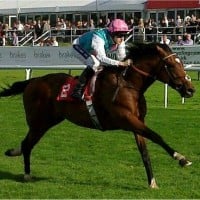
A British Thoroughbred, Frankel is celebrated for his unbeaten record in 14 races, a feat he achieved between 2010 and 2012. Renowned for his powerful acceleration, he was rated as the best racehorse in the world in May 2011. Frankel's success on the track has made him one of the most famous racehorses in recent history.
Not a horse in the classic sense, but rather an unnatural force of nature. On the run-down to the stalls, I would get chills. By the time he was being loaded, I'd start to hear white noise. That's the sound of pure electricity. It hung in the air wherever the horse raced. You could slice the atmosphere with a knife. It was so thick with electricity. No other horse has ever given me these types of sensations.
When he ran, it was pure adrenaline. The air was thick with that too. He exuded it, and the other horses felt it. They all knew who was boss before they even went into the stalls. They could smell it and sense it. Frankel was, is, and will always be the king of all Alphas.
-
Black Caviar
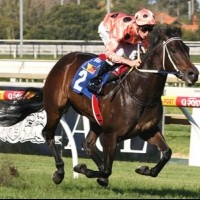
An Australian Thoroughbred, Black Caviar was celebrated for her unbeaten record in 25 races, a rare achievement in horse racing. Known for her exceptional sprinting ability, she was named the World's Top Sprinter in 2010, 2011, and 2012. Black Caviar's racing career, marked by consistent dominance, earned her a dedicated fan base and critical acclaim.
25 for 25, from 5 to 7 furlongs, in the country with the best sprinters in the world. Dominated races by huge margins, in impressive times. Went to England, and despite the jockey easing up early, two injuries, taking the travel terribly, and running on Europe's sloped courses and soft turf for the first time against some very good horses, still won. The greatest sprinter to ever live.
It's hard to compare her against middle-distance horses and beyond, but she's definitely the greatest sprinter ever. She had a cruising speed that was untouchable in the jurisdiction that breeds and races the world's fastest sprinters of this era.
She did stretch to 7 furlongs, but it would be debatable whether she could have repelled the stamina of Frankel at that distance. It surely would have been a race to remember if they had met, and it's a big shame as both were in their physical prime at the same point in time.
Unfortunately, they were on different sides of the planet. Frankel's connections had no financial incentive to travel, and as it turned out, Black Caviar didn't seem to cope well with her trip to England, although she still managed to win. Unfortunately, due to circumstances, Europeans never got to see her awesome ability.
If you compared her to some of the recent dominating performances of Australian sprinters that went to Royal Ascot, then they would have witnessed her winning by a very big margin.
-
Ruffian
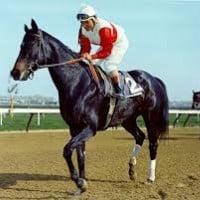
Ruffian, an American filly, was famed for her speed and competitiveness, winning all ten of her races before a tragic accident cut her career short. Known for breaking or equaling track records in each of her victories, she was a symbol of both excellence and tragedy in horse racing. Ruffian's story is often remembered as one of the most heartbreaking in the sport.
Why do people rank a great horse like her 7th? Ruffian was the greatest horse at under a mile, maybe even the greatest ever. She could sprint or stay and would beat anyone and everyone they threw at her. But on that fateful day, she would face a colt for the first time in her life. At the start, she banged her left shoulder on the starting gate and swerved hard on her right foot. Despite any pain, she kept running and in a few strides she was dead even with Foolish Pleasure.
After a brisk three furlongs, a flock of birds flew in front of them and the great filly's ankle snapped. She kept running, pulverizing her sesamoids, ripping the bone through her skin until finally, after 100 yards, she stopped. After 8 hours of trying to save Ruffian's life, she was finally put to rest. Her final resting place is in the infield at Belmont Park, with her nose pointed towards the finish line.
-
Citation
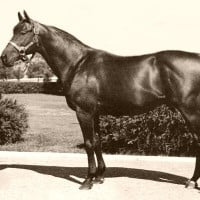
Citation, an American Thoroughbred, dominated post-World War II horse racing, becoming the eighth Triple Crown winner in 1948. Known for his versatility and consistency, he was the first horse to win 16 consecutive major stakes races. Citation's achievements on the track helped solidify his owner Calumet Farm's reputation in horse racing history.
An incredible horse. As a 2yo, he won almost everything, set a track record, and only lost once to future Hall of Fame filly Bewitch, when she won in record time. At the start of his 3yo season, he beat the previous year's HotY twice. Won the American Triple Crown by 17 lengths total, matching the Belmont record. Dominated for the rest of his 3yo season, winning in a track record, then the JCGC by 7 lengths over a Belmont winner, setting a single-season earnings record, having a 15-race win streak, and winning 19 of 20 races in just a year.
As an older horse, he was injured, sidelined for a year, then came back arguably a weaker horse, only to face Noor. Noor set two world records, an American record, and a track record in the four races he won against Citation, all of which Citation also broke while carrying more weight three times. Citation also broke a world record when Noor was absent, so if Noor didn't exist, Citation would've set four world records in a year.
-
Seattle Slew
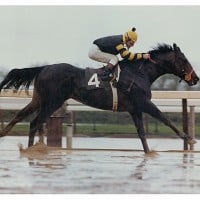
Seattle Slew, a champion American Thoroughbred, is celebrated for winning the Triple Crown in 1977. Remarkably, he was the first horse to win the Triple Crown while undefeated. Known for his powerful build and competitive spirit, Seattle Slew's legacy includes a significant impact as a sire.
I'll never forget his maiden when we all went to the racetrack to see the vaunted Six Crowns (son of Secretariat) run his first race. We went down to the paddock and all of a sudden, this humongous two-year-old was dancing and snorting into the paddock area. There immediately was no doubt as to who would win the race. Six Crowns who? You would never find another race where you could get these odds on Seattle Slew.
When Slew entered the track, the other horses would start foaming. He never had to run for speed, just enough to frustrate his opponent. His best race ever may be one he lost to Exceller. Slew had already defeated the field, including Affirmed in the 1978 Jockey Club Gold Cup. He was easing home with a furlong left when Exceller came charging past on the far outside. Slew caught a glimpse and began a second sprint to nearly catch Exceller at the finish line. He wasn't just a horse, he was a personality.
-
Zenyatta
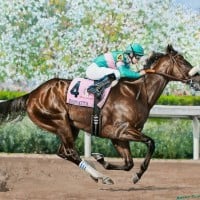
Zenyatta, an American mare, stood out for her remarkable come-from-behind wins, securing victory in 19 of 20 career races. Her most famous victory came in the 2009 Breeders' Cup Classic, where she became the first mare to win the race. Zenyatta's unique racing style and charisma made her a fan favorite and a legend in the racing community.
Zenyatta had a human quality about her. She was an amazing racehorse. I've never seen a horse behind by three lengths with a furlong to go and win the race after kicking into the highest of gears. Zenyatta winning the Breeders' Cup Classic in 2009 was the equivalent of the New England Patriots' Adam Vinatieri winning the 2002 Super Bowl with a field goal on the last play of the game. Even better, possibly? Zenyatta running down St. Trinians in the 2010 Vanity was simply amazing.
If not for jockey error, Zenyatta would have also won the 2010 Classic and gone 20-20 all-time. Mike Smith shook her loose, inexplicably, two seconds too late. She would have beaten Blame going away if he had played that race right. Still, one of the best ever!
-
?
Winx
An Australian mare, Winx is celebrated for her record setting 33 consecutive race wins, including four Cox Plate victories. Known for her remarkable consistency and adaptability, she was named the world's best horse on turf from 2016 to 2018. Winx's career, marked by dominance and longevity, has set a high bar in modern horse racing.
Winx is an exceptional barometer horse. She is a phenomenon. I have never seen a horse win races so comfortably. Her stride rate is extraordinary.
Perhaps she is a modern-day version of Seabiscuit, but she is truly remarkable. She consistently finishes the last 4 furlongs at unprecedented speeds with ease. In this regard, I think she could beat Frankel. In fact, Winx could sit on Frankel and pass him with her sustained burst.
It's interesting because Black Caviar would beat Frankel for sure, up to at least 1200 meters. Winx would likely beat Frankel at 1800 meters and beyond. Having said all this, Phar Lap is on a different level of extraordinariness compared to Winx. While Winx is an all-time great, she pales in comparison to what Phar Lap achieved.
-
?
Flightline
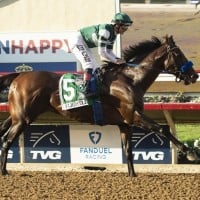
We'll never know how good he truly was.
He never had even a relatively close race and ran incredible speed figures. A dominant athlete.
He never won a race by less than six lengths and was never even asked in any of his races.
-
Sea Bird II
Sea Bird II, a French Thoroughbred, is remembered for his remarkable performances in the 1965 Epsom Derby and the Prix de l'Arc de Triomphe. Known for his effortless running and dominant victories, he is often rated as one of the greatest racehorses in European history. Sea Bird II's racing career remains a high point in the annals of European horse racing.
Perhaps the best French horse ever. Won one of the strongest fields in the Arc by six lengths (another five back to third), as well as the Derby, Prix Lupin, and Grand Prix de Saint-Cloud with insulting ease. Only lost once in eight races, when he started slowly and was jockeyed poorly enough to have a jockey change afterwards in the Grand Critérium, finishing second by two lengths over a mile. He is considered by many to be the best-ever 12-furlong horse for good reason.
Sea Bird was the preeminent racehorse in Europe in the 20th century. He won the Epsom Derby and the Prix de l'Arc de Triomphe on the bridle, the only horse ever to do this. He was so good that he was never extended, so no one knows just how good he was.
I have seen all the great racehorses of the past 50 years, but Sea Bird is the only one who sent shivers up and down my spine. Many people consider him the 'Champion of Champions.'
-
Barbaro
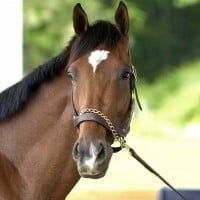
Barbaro, an American Thoroughbred, was widely admired for his victory in the 2006 Kentucky Derby by a margin of 6 1/2 lengths. His promising career was tragically cut short by a leg injury in the Preakness Stakes. Barbaro's subsequent fight for survival and the public's emotional response highlighted the deep connection between racehorses and their fans.
I understand the sentiment of those who think it's not right to put Barbaro on a best racehorse list. For obvious reasons, I agree.
But those people did not see him win the Kentucky Derby in one of the best fields in a very long time. Such a natural! Such ease! No sweat - literally. No foam at the mouth. Just a stroll in the park. He was amazing! I would have bet the farm on his winning the Triple Crown.
In fact, after the Derby, I turned to a friend and said, "It would take something catastrophic to keep this horse from running away with the next two races." He loved to run, and it was so easy for him. So sad.
His career was short, but his Kentucky Derby was one of the strongest ever run. His second-half split was incredible.
His record leading up to that day was as impressive as anything. And if you think he wouldn't have won the Preakness had he not been cut off, forced to slow up, and misstep, you're not being realistic.
That was a very strong field in both the Preakness and the Florida Derby. He was more than just a feel-good story. He was a beast and a machine.
-
Red Rum
A British Thoroughbred, Red Rum is most famous for his unprecedented three victories in the Grand National steeplechase in the 1970s. His ability to overcome a debilitating bone disease early in his career added to his legend. Red Rum's success in one of the world's most challenging races has cemented his status as a national hero in the UK.
Unfortunately, there are too many Americans voting who simply don't appreciate what the Grand National is.
It is the ultimate test over the ultimate jumps over the ultimate distance. To win it once is incredible. To win it twice is phenomenal. To win it thrice is verging on impossible. Add in a win at the Scottish National in the same year, and its other two appearances also being in the top four finishes - it is simply one of the most outrageous achievements anyone has ever heard of.
I mean, I get that Secretariat was a phenomenally quick horse and has shattered records that have stood for years, and still holds those records today. But the Belmont is only a 12-furlong race.
The Grand National, to put it into perspective for people who don't know, is a National Hunt Steeplechase. It involves two laps of the track and over 30 fences. The field is usually around 50 horses but has been as many as 66 before. The fastest time ever recorded is just under nine minutes, and the race is just over four miles long.
Most years, there will be a horse fatality. Most horses that complete the race usually do not return, as the race simply breaks them. There are sometimes the rare, odd horses that can come back and compete in this race two or three times.
Red Rum ran it five times, winning it three times. It was never out of the top four places in its five completions, while also winning the Scottish National in the same year.
For Red Rum to have 2% of the vote in a "Best Ever Horse" poll is an insult to racing.
-
Affirmed
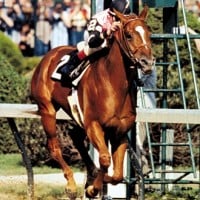
Affirmed, an American Thoroughbred, is renowned for winning the Triple Crown in 1978. His intense rivalry with Alydar, particularly in the 1978 Belmont Stakes, is one of the most famous in horse racing history. Affirmed's achievements on the track established him as one of the leading horses of his generation.
Won more Grade 1 races than any other horse, going 22 for 29 lifetime, racing against Alydar, Seattle Slew, and Spectacular Bid! If you exclude Affirmed from your top ten list, you lose credibility in my opinion.
Affirmed, when he retired, was a horse they knew could set world records. Affirmed broke horses' hearts. They lost the will to ever race again. He is right up alongside Secretariat.
Magnificent horse. He won the Triple Crown races under increasing stretch pressure like no other winner ever endured. He had too much heart to allow Alydar to get his nose in front!
-
Brigadier Gerard
Brigadier Gerard, a British Thoroughbred, is celebrated for winning 17 of his 18 races, including classic victories in the 2000 Guineas and the Queen Elizabeth II Stakes. Known for his tactical speed and intelligence, he was a dominant force in European racing in the early 1970s. Brigadier Gerard's racing prowess left a lasting impression on the British racing scene.
Only ever lost once, in his first ever left-handed race, his sixth race in twelve weeks, with a mild virus, finishing 17 lengths ahead of third in a field full of immense talent, as the incredible Derby winner Roberto ran a race his own team admitted he never came close to matching before or again, breaking the course record by 1.7 seconds.
Brigadier Gerard was dominant from 6 to 12 furlongs, beat the strongest ever 2000 Guineas field with ease by 3 lengths from Mill Reef, arguably the strongest ever field in any mile race, and won even on incredibly soft turf, in weather such that masses of horses dropped out of races, winning in impressive times against some of the best horses in Europe. He had immense endurance too, running eight top-class races in twenty-one weeks. Simply phenomenal.
-
American Pharoah
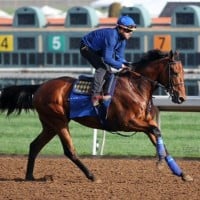
American Pharoah, an American Thoroughbred, achieved international fame by winning the American Triple Crown in 2015, the first to do so in 37 years. Known for his fluid running style and calm demeanor, he also won the Breeders' Cup Classic, completing the Grand Slam of Thoroughbred racing. American Pharoah's success revitalized interest in horse racing across the United States.
I watched him when he won the Arkansas Derby and every race after that. When I saw him run, I just knew that this was the horse to do it. He runs so flawlessly that you can't take your eyes off him. I know he's no Secretariat, and I wasn't around during that time. But to me, he gives you that hope like Secretariat did, and that's all that matters.
Winning the Triple Crown seemed like only a pipe dream, but when he won, it looked like he won it with ease. He turned that dream into reality. Then he won the Breeders' Cup Classic in record time, and I cried when he crossed the finish line. I've never felt that much emotion for any racehorse.
Thank you, Pharoah. You gave me hope, and I hope one day that I will be able to meet you. I think he deserves recognition because he turned non-horse fans into racehorse fans, if that makes sense.
-
Sea the Stars
Sea the Stars, an Irish Thoroughbred, captured global attention with six Group 1 wins in 2009, including the Epsom Derby and Prix de l'Arc de Triomphe. Known for his extraordinary turn of foot and versatility, he dominated Europe's middle-distance racing scene. Sea the Stars' racing career is marked by his consistency and superiority against top-class competition.
To say that Sea the Stars is in this position tells me how completely misguided this list is. Secretariat deserves his place at No. 1 due to his speed records, his Triple Crown win, and the fact that he broke all the records and still holds the Belmont Stakes record 40 years later. That's unbelievable. However, Sea the Stars has achieved something that no horse has ever done, and many have tried: winning the Guineas, Derby, and Arc in the same season, as well as three 10-furlong Group 1 races every month for six months. The two times he was pushed, he broke both race and track records for the distance. He always did enough, but I have no doubt that the better the opposition, the faster this colt could go. For me, he's a very close second to Secretariat.
-
Omaha
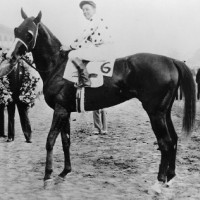
I did a term paper that included Omaha. He was a great racer, and the research proved it.
Wonderful runner, totally underestimated by most.
-
Arkle
Arkle, an Irish Thoroughbred steeplechaser, dominated the National Hunt scene in the 1960s, winning three Cheltenham Gold Cups. Known for his extraordinary jumping ability and strength, he became a national icon in Ireland. Arkle's performances, often while carrying high weights, are legendary in the world of steeplechasing.
Undoubtedly the greatest steeplechaser of all time, and he ran against top-class chasers. Broke their hearts. I am sure he made a mockery of the handicap system. To rate Red Rum above this horse is nonsense. Arkle would have made him look like a selling plater. Alan.
This must be an American site, with all those Yankee horses at the top. If Arkle hadn't been shackled with more weight than the rest, no other horse would have got near him. 24th on this list is laughable, and so is Brigadier Gerard's placing.
-
War Admiral
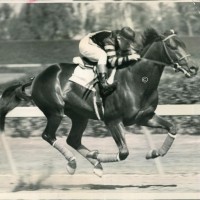
An American Thoroughbred, War Admiral achieved fame by winning the Triple Crown in 1937. Known for his competitive spirit and speed, he was a smaller horse with significant achievements. War Admiral's rivalry with Seabiscuit, culminating in their famous match race in 1938, is a notable chapter in horse racing lore.
Please, War Admiral should be in the top ten for sure. He won the Triple Crown. You have to give him credit for that.
Yes, Seabiscuit beat him, but Seabiscuit is amazing. War Admiral is truly amazing too. One of the best of the best.
One of the best except for one race. Secretariat did not carry the weights that Man o' War, Seabiscuit, and War Admiral did.
-
Native Dancer
Native Dancer, an American Thoroughbred, was a popular horse in the early 1950s, known for his closing speed and charismatic presence. He won 21 of his 22 career starts, with his only loss coming in the 1953 Kentucky Derby. Native Dancer's widespread appeal was amplified by the advent of television, earning him a large fan base.
You guys have got to be kidding. First Whirlaway, then Count Fleet, and now Native Dancer!?! I'm reading the book on him, and he had almost a perfect record. If he had not been bumped in the Kentucky Derby and he was in better condition, he would have won the Triple Crown. He needs to be in the top twenty.
Native Dancer was not only a great racehorse but also a sire of sires, so he must be considered among the best in the world.
Should be in the top 10.
Most exciting come-from-behind winner ever.
Was bumped twice in the Kentucky Derby,
or would have retired undefeated.
-
Mill Reef
One of the best horses to ever run in Britain. Won by consistently dominant margins with ease and was only defeated twice: once as a two-year-old in a sprint and once by Brigadier Gerard in that 2000 Guineas. Unfortunate that his career was cut so short.
Champion 2-year-old and 3-year-old. Coventry, Gimcrack, and Dewhurst, Derby, Eclipse, King George, Arc, then 15-length winner of the Ganay. Ignore the official distance and check out the actual distance. And Coronation Cup as a 4-year-old. Then a successful career at the National Stud. Any ground, no problem. Winning distances. You needed binoculars to see the rest. Simply the best middle-distance turf horse ever.
-
Dancing Brave
Dancing Brave, a British bred Thoroughbred, achieved fame in the 1980s with notable victories in the Prix de l'Arc de Triomphe and the 2000 Guineas. Known for his remarkable turn of foot and late race acceleration, he is considered one of Europe's finest racehorses. Dancing Brave's performances in top level races are remembered for their dramatic and thrilling finishes.
Unmatched turn of foot, such as when he came from not even the top ten to first in 150m, then made another length-and-a-half margin in the final 50 against one of the best fields ever to race. Won the 2000 Guineas by three lengths, came second by half a length to the incredible future eight-length Irish Derby winner Shahrastani under questionable jockeying and an unsuitable pace, with another two and a half lengths back to future G1 winner Mashkour.
His streak included the Eclipse Stakes by four lengths, the King George, the Select Stakes by at least ten lengths in a course record, then the Arc in another record. His Arc, won by one and a half lengths, was against probably the greatest field ever assembled in the history of that race, debatably any race. Unfortunately, he was injured mid-race in his final race, the Breeders' Cup Turf, but he still managed to finish fourth on foreign turf.
-
Kincsem
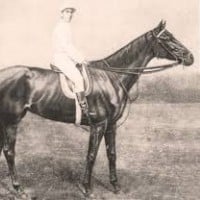
Kincsem, a Hungarian Thoroughbred, holds the unique distinction of being undefeated in all 54 races she entered, a record unparalleled in horse racing history. Racing across Europe in the late 19th century, she became a national icon in Hungary. Kincsem's extraordinary record and durability continue to be celebrated in the racing world.
Kincsem was undefeated in fifty-four starts. This alone is incredible. Now take into account the amazing advantages she gave her opponents in races.
In one race, the starter had all the horses but Kincsem lined up. Kincsem was eating some grass off to the side. People tried to move Kincsem, but she wouldn't budge. So finally, the starter let the other horses go. Kincsem kept eating grass, watching them run away. Then she decided to run. She won.
How many horses do you know of that can stand still at the start of a race and still win? And I think I forgot to mention the weight she carried. If I remember correctly, it went as high as 168 lbs.
-
Rachel Alexandra
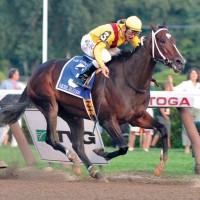
An American Thoroughbred, Rachel Alexandra made history in 2009 by becoming the first filly to win the Preakness Stakes in 85 years. Known for her speed and determination, she achieved victories against both female and male horses. Rachel Alexandra's groundbreaking performances earned her Horse of the Year honors, cementing her status as a racing legend.
The "Wonder Filly" is one of the only fillies to have ever been compared to the great Ruffian. Her 20 1/4 length win in the Oaks was impressive, but her win in the Preakness against the boys was something else entirely. Her time at the Mother Goose Stakes was less than a second slower than the record set by Secretariat. She recently ran against the best male horses in the country at Woodbine, becoming the first filly to ever win that race. She also set a track and course record.
Calvin Borel, who rode Mine That Bird to victory in the 2009 Kentucky Derby and gave up his Preakness ride to jockey Rachel instead, says that she is "the best horse he has ever ridden." His list of horses he has jockeyed is impressive, to say the least.