Top 10 Scariest Tornado Formations
Tornadoes do not all show up looking like the neat little funnel from a kindergarten weather drawing. Nature is far less polite than that. There are several recognized tornado formations, and some of them look like the sky got irritated and started experimenting.
You get shapes that spread wide, pinch thin, bulge in the middle, or hang there in ways that make your brain say, "Nope, absolutely not." So if you grew up thinking every tornado was basically just a cone with an attitude problem, you have been badly underestimating the menu.
That matters, because shape is not just about looks. A tornado's form can change how you read it, how easily you spot it, and how much raw fear it kicks into your spine the second you see it moving across a field or dropping out of a storm base.
The classic cone gets all the fame, but it is hardly the default setting. It is not the strongest by definition, not the deadliest by default, and definitely not the one most likely to make you question every life choice that led you to stand near a window. Some formations look unnervingly solid. Some look weirdly elegant. Some look so wrong that your eyes need a second to accept that yes, the atmosphere really is doing that.
This list is about those forms. The ones that make your stomach drop faster than the barometer. The ones that look less like weather and more like the sky trying out horror special effects on a live audience.
-
Wedge Tornado
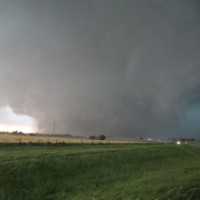
A wedge tornado appears at least as wide at the surface as it is tall. This broad wall of rotating clouds swallows the horizon.
Looks like a whole storm of clouds! You won't know if it is just fog or the actual tornado. Jeez, I wouldn't like to be on the road with it!
-
Bowl-Shaped Tornado
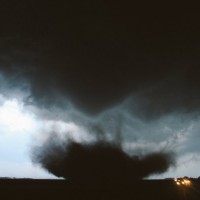
This vortex features a wide cloud base that curves inward to form a blunt bottom. The suspended funnel visually replicates an inverted bowl.
-
Convex-Sided Tornado
The outer walls of this twister bow outward in the middle rather than sloping inward. It bulges significantly between the storm clouds and the dirt.
-
Hourglass Tornado
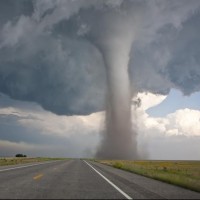
Broad circulation at both the cloud base and the ground connects via a pinched middle section. The tapered center perfectly mirrors a sand timer.
-
Cylinder Tornado
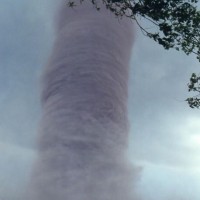
This vertical vortex maintains a strict uniform width from the sky down to the surface. It completely lacks a tapering point.
Scary! By the way, please put double tornadoes on here! They have actually happened before.
-
Cone Tornado
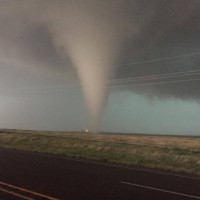
This circulation starts with a wide footprint at the storm base and narrows to a point at the ground. It serves as the most frequently documented twister profile.
-
Bulb-Shaped Tornado
A narrow upper funnel connects to a distinctly rounded base near the surface. The concentrated lower expansion resembles a glass lightbulb.
-
Cigar Tornado
A cigar tornado features a massive, cylindrical funnel that maintains a nearly uniform width from the storm cloud down to the earth. The elongated structure simply hovers like a smoking cigar.
-
Concave-Sided Tornado
The external walls of this twister curve sharply inward toward the central vertical axis. Sweeping flares define both the top and bottom connections.
-
Sheathed Tornado
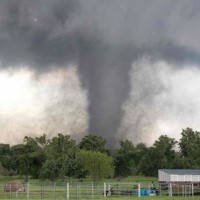
A central condensation funnel spins while surrounded by an outer envelope of rotating dust. Observers catch glimpses of the inner vortex through the exterior shroud.
-
?
Rain-Wrapped Tornado
Dense curtains of heavy precipitation completely hide the rotating funnel from visual observation. The concealed twister travels undetected inside a blinding downpour.
You can't see it due to the heavy rain.
-
?
Multi-Vortex Wedge Tornado
A broad primary circulation contains several smaller suction vortices revolving around the main center. The width of this primary funnel exceeds its total height.
What is scarier than a good old wedge, a multivortex wedge which has subvortices.
-
Double Tornado
Two separate funnels descend simultaneously from the exact same supercell thunderstorm. They rotate around a shared center of gravity while tracking a unified path.