Top 10 Weapons in Middle Earth Lore
You walk in lands where shadow and flame have risen, where kings and halflings alike have carried blades with names older than empires. The weapons of Middle-earth are not mere tools of war. They are heirlooms, songs in steel, laden with sorrow or glory, often both. Some lie hidden in deep places, others ride the hips of those fated to challenge the dark. Each carries with it the weight of its making, the will of its master, and the memory of every foe it has felled.
Here, you are called to lend your voice. Not to the forging, but to the reckoning. Which of these weapons would you lift in battle? Which would you entrust to the hand of a hero? Vote for the blades, bows, and cursed rings you believe should rise to the heights of legend. Let your judgment echo among the halls of Valinor and the ruins of Angmar alike.
-
Ringil
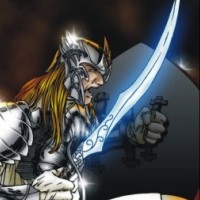
Anything from the Silmarillion is awesome, swords included.
-
Glamdring
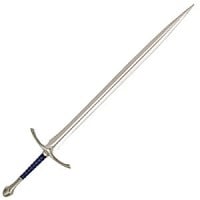
Its name is Sindarin for "Foe-Hammer". Also called "Beater" by orcs, this sword was originally forged for Turgon, the King of Gondolin. But it is best known as the sword Gandalf wielded during the War of the Ring. In Tolkien's writings, Glamdring's color when glowing is always described as white. The sword is inscribed with runes in the Elven language. In the movies, the runes say, "Turgon Aran Gondolin, Tortha gar a matha Glamdring, Vegil Glamdring gûd daelo. Dam an Glamhoth," which translates to "Turgon, King of Gondolin, wields, has, and holds the sword Glamdring, Foe of Morgoth's realm, Hammer of the Orcs."
It can summon fire.
-
Sting
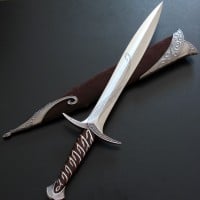
Sting was an Elven shortsword made in Gondolin during the First Age. Sting was like Glamdring and Orcrist in that "being the work of Elvish smiths in the Elder Days, these swords shone with a cold light if any Orcs were near at hand." But only Sting was definitively described as glowing blue, or glittering with blue flame at its edges. After wielding it during the Quest for Erebor, Bilbo Baggins had it engraved with the Sindarin text, "Maegnas aen estar nin dagnir in yngyl im." Translated into English, it reads, "Sting is my name. I am the spider's bane."
-
One Ring
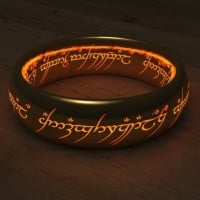
Oh, wow, you're right. How could I forget to add this? I was thinking more of physical weapons than pure magical ones.
Uhhh, people, are you forgetting something?
You know, the thing that can destroy EVERYTHING!
-
Orcrist
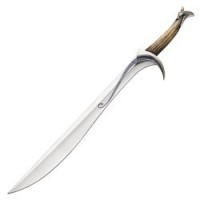
The name Orcrist means "Goblin-cleaver," derived from "Orc" and the Sindarin "ris" ("to cut"). The Orcs also referred to it as "Biter." Orcrist and its "mate" Glamdring are described in The Hobbit as having "beautiful scabbards and jeweled hilts."
The sword is noted for having "killed hundreds of goblins in its time." The original wielder of the sword is not explicitly mentioned in any of Tolkien's writings. However, it is widely speculated that it was one of the Lords of the Gondolindrim, particularly Ecthelion of the Fountain, who led a charge and killed countless Orcs with his sword.
The fear of Orcrist among the Orcs of the Misty Mountains may be attributed to this. Orcrist became the sword of Thorin Oakenshield during The Quest for Erebor. After his death, the sword was placed on Thorin's tomb under the Lonely Mountain, and it "gleamed ever in the dark if foes approached."
-
Dramborleg
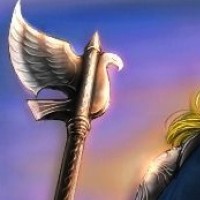
In the language of the Gondolindrim, Dramborleg means "Thudder-sharp," from "daram" ("beat, hew") or "dram" ("heavy stroke"). Dramborleg was the great axe wielded by Tuor during the First Age.
During the Fall of Gondolin, Tuor used Dramborleg to clove five Balrogs to death.
-
Morgul-blade
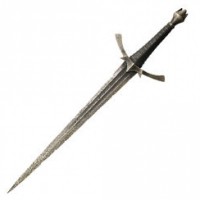
Morgul-blades, also known as "Morgul-knives," were magical and poisonous daggers wielded by the Ringwraiths during the Third Age. After cutting flesh, the dagger breaks, leaving a shard of the blade in its victim. The remainder of the blade soon turns to dust, and the shard migrates through the body towards the heart. If the shard remains in the victim for an extended period, the victim turns into a wraith.
In Frodo's case, Elrond managed to remove the shard and heal the wound. However, on the anniversary of the injury from the Morgul-blade, Frodo would become seriously ill each year. Only his eventual journey to the Undying Lands provided a permanent solution.
-
Angrist
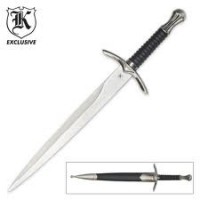
In Sindarin, Angrist means "Iron-cutter," from "ang" ("iron") and "ris" ("to cut"). Angrist was a knife made by a famous Dwarven smith, and borne by Curufin, one of Fëanor's sons.
It was used to cut a Silmaril out of Melkor's Iron Crown.
-
Aeglos
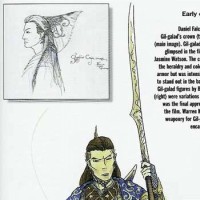
Aeglos, or Aiglos, was the famed glaive of Gil-galad, the last High King of the Ñoldor, and was used during the War of the Last Alliance. Its name means "snow-point" or "icicle." It was called such because, when orcs saw this spear, they would recognize it by its reputation as a weapon that would bring a cold death to them.
In the movies, the blade bears the following Elvish inscription:
Gil-galad ech vae vaegannen matha
Aith heleg nín I orch gostatha
Nin cíniel na nguruthos
Hon ess nín istatha: Aeglos
(Gil-galad wields a well-made spear
The Orc will fear my point of ice
When he sees me, in fear of death
He will know my name: Aeglos)
-
Gurthang
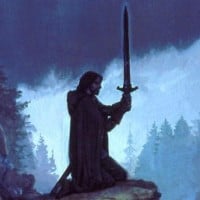
"The sword Anglachel was forged anew... by the cunning smiths of Nargothrond, and though ever black, its edges shone with pale fire."
Gurthang was the sword of Túrin Turambar. Its name means "Iron of Death." Túrin used Gurthang to slay the dragon Glaurung. When Túrin discovered that his wife, Nienor Níniel, was also his sister, and that she had killed herself, Túrin, in despair, fell upon Gurthang, killing himself and breaking the blade beneath him.
But first, according to the tale, the sword seemed to have a will of its own and spoke to Túrin. The shards of Gurthang were buried with him.
-
?
Black Arrow
This was the arrow that killed Smaug. No idea why it isn't higher.
-
?
Grond (Battering Ram)
-
Andúril
I love that name.
-
Narsil
The sword that Isildur used to kill Sauron.
-
Phial of Galadriel
-
Galadhrim Bow
-
Grond (Morgoth's Hammer)
-
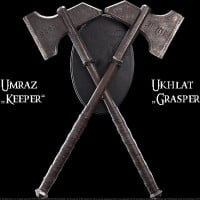
Grasper and Keeper
-
Bard's Sword
-
Legolas's Bow